
Transdisciplinary Synergy in Inclusive Early Childhood Education: Integrating Special Education Expertise and Strategic Management for Service Quality
##plugins.themes.bootstrap3.article.sidebar##
##plugins.themes.bootstrap3.article.main##
 Dewi Cahyaningrat
 https://orcid.org/0009-0009-8367-1267
 Azlan Bin Saflie
Abstract
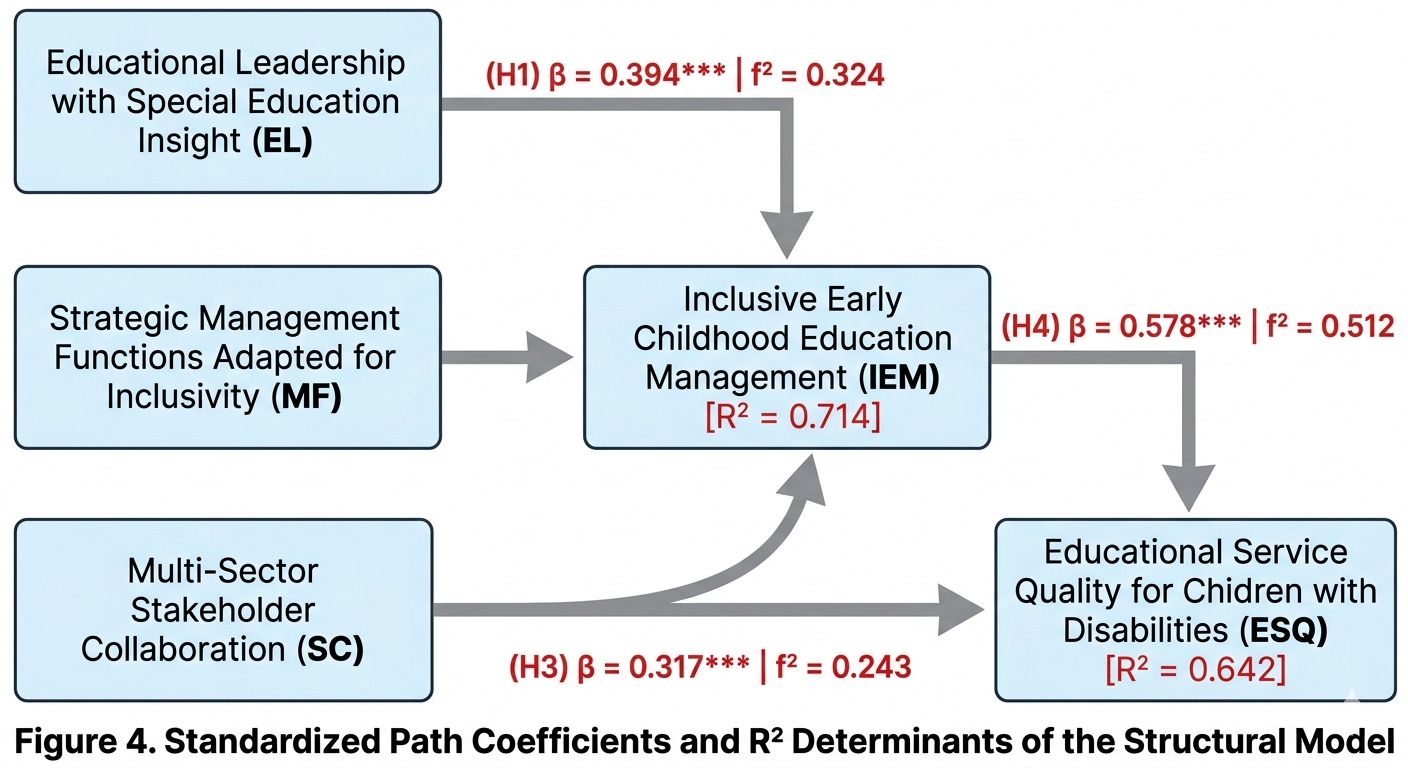
Purpose: This study aims to analyze the convergence between early childhood special education expertise and strategic management science—viewed as a social-institutional factor—on inclusive early childhood education (ECE) management and its subsequent impact on service quality for children with disabilities in Serang City, Banten Province, Indonesia. Methodology: This quantitative explanatory study involved 168 respondents (38 principals and 130 teachers) from 38 ECE institutions selected through purposive sampling. Data were collected using structured questionnaires with a five-point Likert scale and analyzed using PLS-SEM with SmartPLS 4.0. Instrument content validity was ensured through expert judgment by three academic panelists. Findings: The results demonstrate that educational leadership with special education insight (β = 0.394; p < 0.001), strategic management functions adapted for inclusivity (β = 0.331; p < 0.001), and multi-sector stakeholder collaboration (β = 0.317; p < 0.001) positively influence inclusive ECE management. Inclusive ECE management significantly enhances educational service quality (β = 0.578; p < 0.001). The collaboration between these distinct disciplines explains 71.4% of the variance in inclusive ECE management (R² = 0.714). The study confirms that collaborative capability serves as a Valuable, Rare, Inimitable, and Non-substitutable (VRIN) strategic resource. Implications: The findings emphasize the critical importance of transdisciplinary synergy between special education specialists and strategic management practitioners. Recommendations include establishing interdisciplinary teams at the institutional level, developing integrated training programs, and designing collaborative policy frameworks to foster sustainable institutional change. Originality/Value: Grounded in the Resource-Based View (RBV) theory, this research provides the first empirical evidence regarding the synergistic value of combining management science and special education within the K-12 ecosystem. It demonstrates that social-institutional factors, driven by expertise collaboration, are the primary keys to effective inclusive education.
Downloads
##plugins.themes.bootstrap3.article.details##
Copyright (c) 2026 Dewi Cahyaningrat, Dian Sudiantini, Azlan Bin Saflie

This work is licensed under a Creative Commons Attribution-ShareAlike 4.0 International License.
References
Abolfotoh, I. S. (2025). NeGreat the Danger When Unseen; Greater When Lost: An Ecocritical Poetic Study of Marine Micro and Nanoplastic Pollution. Jordan Journal of Modern Languages and Literatures, 17(4), 1179–1198. https://doi.org/10.47012/jjmll.17.4.16
Agbenyega, J. S., & Klibthong, S. (2022). Giving voice: inclusive early childhood teachers’ perspectives about their school leaders’ leadership practices. International Journal of Leadership in Education, 1–17. https://doi.org/10.1080/13603124.2022.2052761
Algül, F., & Şenol, F. B. (2026). Augmented reality-enhanced drama: fostering social information processing in early childhood*. Early Years. https://doi.org/10.1080/09575146.2026.2635622
Ametefe, D. S., Sukor, N. S. A., John, D., Ametefe, G. D., Aliu, A. A., Owen, M. M., & Olaidey, S. T. (2026). Intelligent Battery Systems: System-Level Integration of Data-Driven Learning, Optimisation and Predictive Management. Battery Energy, 5(2). https://doi.org/10.1002/bte2.70099
Ardiansyah, S., Komalasari, K., Maryani, E., & Wiyanarti, E. (2024). Transformation of Bima local wisdom values through social studies e-book media. Journal of Education and Learning, 18(2), 535–543. https://doi.org/10.11591/edulearn.v18i2.21004
Awill, R., Khan, W. A., Hussain, M., Anderson, B., & Kazmi, S. M. A. (2026). ATLASky-AI: An autonomous framework for physics-based trustworthy verification of LLM-generated spatiotemporal knowledge. Expert Systems with Applications, 318. https://doi.org/10.1016/j.eswa.2026.131801
Barnes, L. P. (2021). The character of Controlled schools in Northern Ireland: A complementary perspective to that of Gracie and Brown. International Journal of Christianity and Education, 25(3), 337–348. https://doi.org/10.1177/20569971211008940
Chion, C., Cantin, G., Dionne, S., Dubeau, B., Lamontagne, P., Landry, J.-A., Marceau, D., Martins, C. C. A., Ménard, N., Michaud, R., Parrott, L., & Turgeon, S. (2013). Spatiotemporal modelling for policy analysis: Application to sustainable management of whale-watching activities. Marine Policy, 38, 151–162. https://doi.org/10.1016/j.marpol.2012.05.031
Chookah, H. A., Agbenyega, J. S., Santos, I. M., & Habak, C. (2024a). Play Affordances of Natural and Non-natural Materials in Preschool Children’s Playful Learning Tasks. International Journal of Early Childhood, 56(3), 585–603. https://doi.org/10.1007/s13158-023-00348-z
Chookah, H. A., Agbenyega, J. S., Santos, I. M., & Habak, C. (2024b). Play Affordances of Natural and Non-natural Materials in Preschool Children’s Playful Learning Tasks. International Journal of Early Childhood, 56(3), 585–603. https://doi.org/10.1007/s13158-023-00348-z
Dan, B. A., Szűcs, T., Sávai-Átyin, R., Hrabéczy, A., Kovács, K. E., Ridzig, G., Kis, D., Bacskai, K., & Pusztai, G. (2024). Narrowing the inclusion gap -- teachers and parents around SEN students. International Journal of Inclusive Education, 29(14), 2485–2511. https://doi.org/10.1080/13603116.2024.2361102
Elza, C. (2014). Alice in Cartoonland: Childhood, gender, and imaginary space in early disney animation. Animation, 9(1), 7–26. https://doi.org/10.1177/1746847714520936
Eybers, S., Kroeze, J. H., & van Staden, C. J. (2026). Inclusive Education for All: Online Instructional Course Design Guidelines for Curriculum Transformation. In F. Corradini, K. Hinkelmann, H. Smuts, & B. Re (Eds.), Communications in Computer and Information Science: 2787 CCIS (pp. 98–111). Springer Science and Business Media Deutschland GmbH. https://doi.org/10.1007/978-3-032-15463-7_9
Fleer, M. (2011). Technologically constructed childhoods: Moving beyond a reproductive to a productive and critical view of curriculum development. Australian Journal of Early Childhood, 36(1), 16–24. https://doi.org/10.1177/183693911103600104
Galam, S., & Brooks, R. R. W. (2022). Radicalism: The asymmetric stances of radicals versus conventionals. Physical Review E, 105(4). https://doi.org/10.1103/PhysRevE.105.044112
Galera-Núñez, M., de Frutos-Domínguez, R., & Duarte-Piña, O. (2026a). Echoes of childhood: songs that have left their mark on future early childhood educators. Music Education Research, 28(1), 23–36. https://doi.org/10.1080/14613808.2025.2567934
Galera-Núñez, M., de Frutos-Domínguez, R., & Duarte-Piña, O. (2026b). Echoes of childhood: songs that have left their mark on future early childhood educators. Music Education Research, 28(1), 23–36. https://doi.org/10.1080/14613808.2025.2567934
Giacumo, L. A., Villachica, S. W., & Stepich, D. A. (2024). INSTRUCTIONAL DESIGN FOR ORGANIZATIONAL JUSTICE: A Guide to Equitable Learning, Training, and Performance in Professional Education and Workforce Settings. In Instructional Design for Organizational Justice: A Guide to Equitable Learning, Training, and Performance in Professional Education and Workforce Settings. Taylor and Francis. https://doi.org/10.4324/9781003360612
Hardiani, A. F., & Hendriani, W. (2025). Optimalisasi Intervensi pada Peran Guru dalam Pendidikan Inklusi: Sebuah Systematic Literature Review Berbasis Index for Inclusion. Jurnal Pendidikan Inklusi, 5(3), 18–30. https://doi.org/10.62491/njpi.2025.v5i3-18
Hariyanti, F., Darmayanti, R., Rachmatika, F., Zuhri, Z., Sumantri, C. M. S., & ... (2026). Konsep Dasar IPA Berbasis OBE: Buku Ajar Perguruan Tinggi. In UNU PASURUAN PRESS (Vol. 3, pp. 1–220). https://scholar.google.com/citations?view_op=view_citation&hl=en&user=3YBrj-MAAAAJ&cstart=200&pagesize=100&citation_for_view=3YBrj-MAAAAJ:MLH2VaVdO9oC
Jacobsson, A., Hellman, A., Abate, E., Weldemariam, K., Tesar, M., & Yelland, N. (2026). A global childhoods research collective: Conceptualising global childhoods through reflections and imperatives from Australia, Ethiopia, New Zealand and Sweden. Global Studies of Childhood, 16(1 Themed Issue: 15th anniversary issue), 6–19. https://doi.org/10.1177/20436106251325871
Johansson, V. M. F., & Herrebrøden, M. K. (2025). Cultivating inclusive schools: the role of extended professional learning communities. Educational Research, 1–19. https://doi.org/10.1080/00131881.2025.2548263
Kanarik, H., Tuomi, L., Alenius, P., Miettunen, E., Johansson, M., Roine, T., Westerlund, A., & Kahma, K. K. (2025). Currents and their drivers in the Archipelago Sea: Insights from ADCP measurements. Ocean Science, 21(5), 2125–2147. https://doi.org/10.5194/os-21-2125-2025
Kholifah, N., Nurtanto, M., Mutohhari, F., Majid, N. W. A., & Fawaid, M. (2024). The Role of Digital Technology Competency and Psychological Capital in Vocational Education Students: The Mediating Role of Entrepreneurial Self-Efficacy. Journal of Technical Education and Training, 16(3), 238–250. https://doi.org/10.30880/jtet.2024.16.03.017
Khoo, K. L., Sidhu, S. K., Goh, S. K., & Dastane, O. (2026). Bridging research, industry, and qualification frameworks in marketing education: A multi-study investigation. International Journal of Management Education, 24(2). https://doi.org/10.1016/j.ijme.2026.101392
Kristina, M., Ying, L. S., Lina, S., Andrėjus, S., Povilas, I., Tomas, B., & Olga, R. (2025). Multidimensional pedagogical framework for interprofessional education: Blending classroom, high fidelity and extended reality simulation. Nurse Education Today, 154. https://doi.org/10.1016/j.nedt.2025.106838
Kugel, G., Arsenault, P., & Papas, A. (2009). Treatment modalities for caries management, including a new resin infiltration system. Compendium of Continuing Education in Dentistry (Jamesburg, N.J. : 1995), 30 Spec No 3, 1-10;quiz11. https://www.scopus.com/pages/publications/75349088915?origin=resultslist
Mispani, M., Setiawan, A., Choirudin, C., Maba, A. P., Darmayanti, R., Karim, S., & ... (2026). Transformational Management of Islamic Higher Education: A Case Study of A Nahdlatul Ulama Affiliated University in Enhancing Academic Quality and Global Competitiveness. Nazhruna: Jurnal Pendidikan Islam, 9(1), 280–295. https://scholar.google.com/citations?view_op=view_citation%5C&hl=en%5C&user=3YBrj-MAAAAJ%5C&cstart=200%5C&pagesize=100%5C&citation_for_view=3YBrj-MAAAAJ:KU5Jek27JVwC
Mulyaningsih, I., Jan-Kaew, T., Ekawati, T., Nurpadillah, V., & Rahman, M. A. (2026). CONSTRUCTING CULTURAL IDENTITY IN BIPA PEDAGOGY: A CRITICAL DISCOURSE ANALYSIS OF AR-ENHANCED LEARNING MATERIALS BASED ON CIREBON HERITAGE. Jurnal Gramatika, 12(1), 14–27. https://doi.org/10.22202/jg.v12i1.10607
Murawska, N., Jarašiūnaitė-Fedosejeva, G., Pawlicka, P., Riklikienė, O., Škodová, Z., Michałek-Kwiecień, J., & Kaźmierczak, M. (2026). Prevalence and risk factors of childbirth-related post-traumatic stress disorder symptoms - comparison study of Central-Eastern European countries: Poland, Slovakia, and Lithuania. Journal of Affective Disorders, 392. https://doi.org/10.1016/j.jad.2025.120102
Mutohar, P. M., & Trisnantari, H. E. (2020). THE EFFECTIVENESS OF MADRASAH: ANALYSIS OF MANAGERIAL SKILLS, LEARNING SUPERVISION, SCHOOL CULTURE, AND TEACHERS’ PERFORMANCE. Malaysian Online Journal of Educational Management, 8(3), 21–47. https://doi.org/10.22452/mojem.vol8no3.2
Nechoska, D. K., Nechkoska, R. P., Duma, R., & Bogdanoska, M. J. (2025). AI-based traffic control and management systems-A synthesis of Macedonian research experiences. In M. Zanne, P. Bajec, & E. Twrdy (Eds.), Transportation Research Procedia (Vol. 83, pp. 513–519). Elsevier B.V. https://doi.org/10.1016/j.trpro.2025.03.020
Perra, V.-M., & Boile, M. (2025). Developing a Monitoring and Evaluation Framework for Sustainable Maritime Spatial Planning: A Stakeholder-Driven Approach. Sustainability (Switzerland), 17(13). https://doi.org/10.3390/su17135813
Pinuela, M. F. G. (2025). Design and development of instructional materials to enrich K to 12 STEM Biology II curriculum guide: a case of the province of Iloilo, Philippines. Cogent Education, 12(1). https://doi.org/10.1080/2331186X.2025.2495530
Rhijn, T. V, Underwood, K., Frankel, E., Lero, D. S., Spalding, K., Janus, M., Friendly, M., & Hach, A. (2021). Role of Child Care in Creating Inclusive Communities and Access for All. Canadian Public Policy, 47(3), 399–409. https://doi.org/10.3138/cpp.2021-010
Rhijn, T. van, Maich, K., Lero, D. S., & Irwin, S. (2019). Assessing Inclusion Quality. Exceptionality Education International, 29(3), 92–112. https://doi.org/10.5206/eei.v29i3.9389
Rioseco-Pais, M., Silva-Quiroz, J., & Vargas-Vitoria, R. (2024). Digital Competences and Years of Access to Technologies Among Chilean University Students: An Analysis Based on the DIGCOMP Framework. Sustainability (Switzerland), 16(22). https://doi.org/10.3390/su16229876
Riowati, R., Hendriani, W., & Paramita, P. P. (2025). School-Based Inclusive Education Management as a Quality Assurance System in Indonesia (Systematic Literature Review). Jurnal Kependidikan: Jurnal Hasil Penelitian Dan Kajian Kepustakaan Di Bidang Pendidikan, Pengajaran Dan Pembelajaran, 8(2), 437–446. https://doi.org/10.33394/jk.v8i2.4363
Sarmurzin, Y., Ospanova, B., Kerimbekova, B., Dauletkulova, A., & Amanova, A. (2026). “We have stolen our kids’ childhood”: parents’ and teachers’ perspectives on shadow education in Kazakhstan. Asia Pacific Education Review. https://doi.org/10.1007/s12564-026-10105-1
Shaikh, A. L., & Alam Kazmi, S. H. (2022). Exploring marketing orientation in integrated Islamic schools. Journal of Islamic Marketing, 13(8), 1609–1638. https://doi.org/10.1108/JIMA-11-2019-0241
Slizhe, M., Safranov, T., Berlinsky, N., & El Hadri, Y. (2023). Impact of climate change factor on the resource (providing) ecosystem services of the Lower Danube wetlands. Visnyk of V. N. Karazin Kharkiv National University, Series “Geology. Geography. Ecology,” 2023(59), 307–319. https://doi.org/10.26565/2410-7360-2023-59-23
Solihin, M., Darmayanti, R., & Auliya, F. R. (2026). Development and Validation of Adaptive Learning Platform (ALP) to Improve Challenge-Based Mathematical Numeracy Literacy in Local Shoe Manufacturing Entrepreneurs. In Edutechnium Journal of Educational Technology (Number 2, pp. 1–17).
Steinhagen, S., Johansson, I., Specht, J., Enge, S., Larsson, K., Undeland, I., & Toth, G. B. (2025). Unlocking economic potential of the Ulva crop for low salinity environments: exploring the effect of salinity gradients on the performance and valuable compounds of Baltic Sea strains. Botanica Marina, 68(1), 65–82. https://doi.org/10.1515/bot-2024-0079
Vijaychandran, D., Maulik, S., & Gupta, P. (2025). Bridging the Gap: A Qualitative Study on the Design Educator’s Perspective at Curriculum Planning Stage. In A. Chakrabarti, V. Singh, P. S. Onkar, & M. Shahid (Eds.), Lecture Notes in Mechanical Engineering (Vol. 96, pp. 421–432). Springer Science and Business Media Deutschland GmbH. https://doi.org/10.1007/978-981-96-6414-6_35
Wilke, A., van Rhijn, T., Squires, K., & Barton, K. (2024a). Digital Bonds: Exploring the Impact of Computer-Mediated Communication on Parent–Educator Relationships in Early Childhood Education and Care. Education Sciences, 14(2). https://doi.org/10.3390/educsci14020123
Wilke, A., van Rhijn, T., Squires, K., & Barton, K. (2024b). Digital Bonds: Exploring the Impact of Computer-Mediated Communication on Parent–Educator Relationships in Early Childhood Education and Care. Education Sciences, 14(2). https://doi.org/10.3390/educsci14020123
Xavier, B. G., da Silva, L. V, Alves, F. C., Teixeira, L. V, & Santos, V. E. N. (2024). Circular bioeconomy ecosystems: Hydroxyapatite from fish waste at Rio de Janeiro. Biofuels, Bioproducts and Biorefining, 18(2), 378–390. https://doi.org/10.1002/bbb.2592
Yamin, M., Jufri, A. W., Borhan, M. T., & Hardianti, B. S. W. (2025). CONTEXTUAL LEARNING WITH MEGAPODIUS REINWARDT ECOTOURISM: A SUSTAINABLE EDUCATION APPROACH AND ITS IMPACT ON STUDENTS’ SCIENCE PROCESS SKILLS. Jurnal Pendidikan IPA Indonesia, 14(4), 678–690. https://doi.org/10.15294/jpii.v14i4.31292
Young, S. (2009). Towards constructions of musical childhoods: Diversity and digital technologies. Early Child Development and Care, 179(6), 695–705. https://doi.org/10.1080/03004430902944908