
Environmental Citizenship Behavior in the Workplace: The Roles of Green HRM and Employee Engagement and Implications for Sustainability Education
##plugins.themes.bootstrap3.article.sidebar##
##plugins.themes.bootstrap3.article.main##
 Eteh Resa Asyifa
Dian Sudiantini
 Azlan Bin Saflie
Abstract
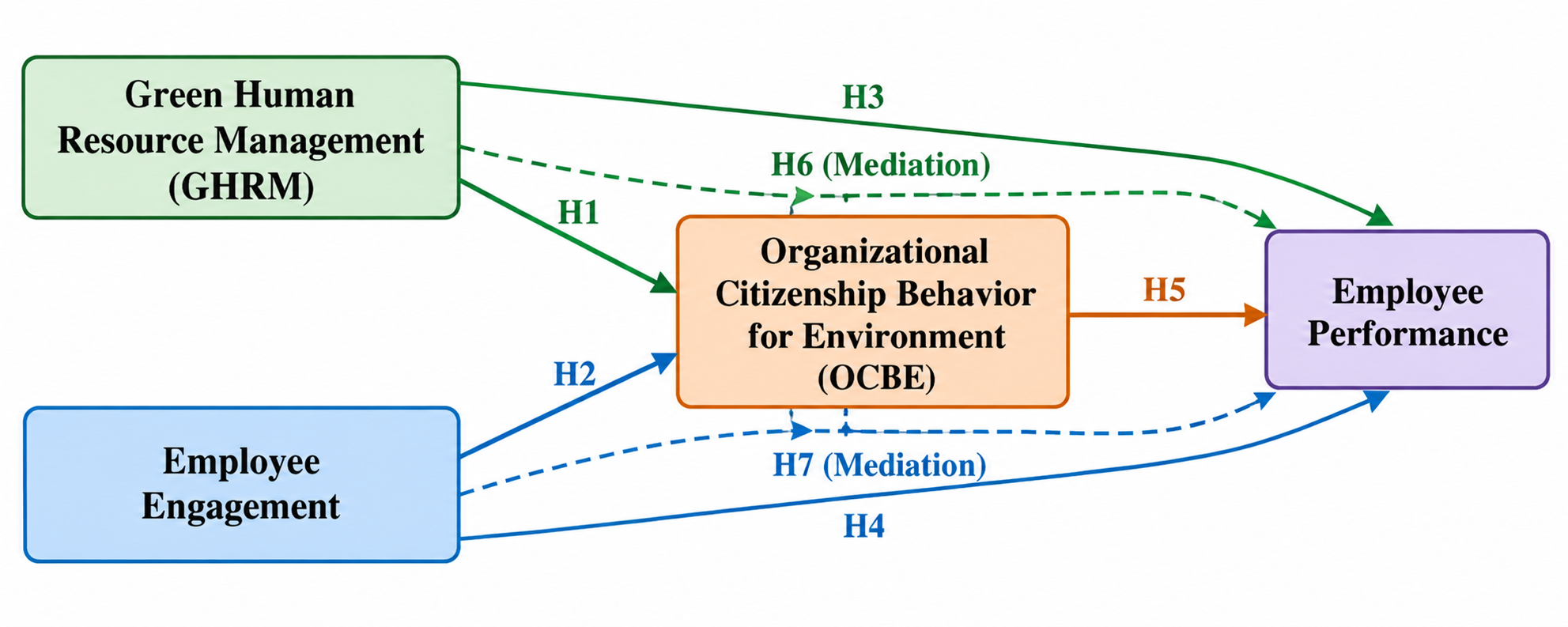
Environmental sustainability requires not only organizational policies but also the development of voluntary environmental behaviors that can be strengthened through continuous learning, engagement, and environmentally responsible practices. This study examines the mediating role of Organizational Citizenship Behavior for Environment (OCBE) in the relationships between Green Human Resource Management (GHRM), Employee Engagement, and Employee Performance in the manufacturing sector. Using a quantitative explanatory design, data were collected from 156 permanent employees of manufacturing companies in Cirebon, West Java, Indonesia, selected through purposive sampling. The relationships among the constructs were analyzed using Structural Equation Modeling–Partial Least Squares (SEM-PLS) with SmartPLS 4.0. The findings show that GHRM and Employee Engagement positively and significantly influence OCBE. OCBE also positively influences Employee Performance and partially mediates the relationships between GHRM and Employee Performance and between Employee Engagement and Employee Performance. These findings indicate that structured environmental practices and employee psychological engagement can encourage voluntary pro-environmental behavior as a mechanism linking organizational initiatives with individual performance. From a broader educational perspective, the findings offer conceptual implications for sustainability-oriented learning by demonstrating how environmental values may be reinforced through training, engagement, behavioral modeling, and supportive institutional practices. The study therefore extends the discussion of environmental citizenship beyond organizational performance toward the development of sustainability-oriented behavior relevant to lifelong and transformative environmental learning.
Downloads
##plugins.themes.bootstrap3.article.details##
Copyright (c) 2026 Eteh Resa Asyifa, Dian Sudiantini, Azlan Bin Saflie

This work is licensed under a Creative Commons Attribution-ShareAlike 4.0 International License.
References
Ababneh, O. M. A. (2021). How do green HRM practices affect employees’ green behaviors? The role of employee engagement and personality attributes. Journal of Environmental Planning and Management, 64(7), 1204–1226. https://doi.org/10.1080/09640568.2020.1814708
Abbas, I., & Ganesan, S. (2025). Exploring the feasibility of AI-driven educational robots in simulation environments for early childhood learning: A pilot study. IEEE International Conference on Electro Information Technology, 173–181. https://doi.org/10.1109/eIT64391.2025.11103623
Afsar, B., & Umrani, W. A. (2021). Does thriving and trust in the leader explain the link between green HRM and employees’ pro-environmental behaviour? A social exchange perspective. Journal of Hospitality and Tourism Management, 48, 240–250. https://doi.org/10.1016/j.jhtm.2021.06.008
Ahmad, I., Kifayat, U., & Khan, A. (2022). The impact of green HRM on green creativity: Mediating role of pro-environmental behaviors and moderating role of ethical leadership style. The International Journal of Human Resource Management, 33(19), 3789–3821. https://doi.org/10.1080/09585192.2021.1931938
Ahmed, H., Nisar, Q. A., Khan, W., Patwary, A. K., & Zaman, S. (2023). Does green HRM really matter for sustainable performance? The role of environmental consciousness and green intellectual capital. Environmental Science and Pollution Research, 30(54), 115882–115897. https://doi.org/10.1007/s11356-023-30644-z
Akinci, M., Yildirim, F., Kocak, S., Turkoglu, B., & Demir, B. (2026). A qualitative evaluation of the social work curriculum: Focusing on sustainable development and ecological justice. International Journal of Sustainability in Higher Education, 27(2), 322–339. https://doi.org/10.1108/IJSHE-10-2023-0479
Akrim, A. (2022). Transformation of Islamic education curriculum development policy in the national education system. Cypriot Journal of Educational Sciences, 17(7), 2538–2552. https://doi.org/10.18844/cjes.v17i7.7685
Al Doghan, M. A. (2024). Green HRM practices, green capability and green performance: The avenues towards greener economy. Cogent Business & Management, 11(1), 2418418. https://doi.org/10.1080/23311975.2024.2418418
Al-Omari, E. (2024). Innovative curriculum development: Embracing the concept-based approach in nursing education. Teaching and Learning in Nursing, 19(4), 324–333. https://doi.org/10.1016/j.teln.2024.04.018
Alshaabani, A., Naz, F., Magda, R., & Rudnák, I. (2021). Impact of perceived organizational support on OCB in the time of COVID-19 pandemic in Hungary: Employee engagement and affective commitment as mediators. Sustainability, 13(14), 7800. https://doi.org/10.3390/su13147800
Alzgool, M. (2021). Nexus between green HRM and green management towards fostering green values. Management Science Letters, 11(3), 1013–1020. https://doi.org/10.5267/j.msl.2020.9.032
Anwar, N., Mahmood, N. H. N., Yusliza, M. Y., Ramayah, T., Faezah, J. N., & Khalid, W. (2021). Green Human Resource Management for organisational citizenship behaviour towards the environment and environmental performance on a university campus. Journal of Cleaner Production, 284, 124749. https://doi.org/10.1016/j.jclepro.2020.124749
Badan Pusat Statistik Kota Cirebon. (2023). Kota Cirebon dalam angka 2023. Badan Pusat Statistik Kota Cirebon.
Baena-Morales, S., Froberg, A., Lundvall, S., & García-Taibo, O. (2026). How to bridge the physical education curriculum and competencies for sustainable development? Pre-service teachers’ perspectives. Sport, Education and Society. https://doi.org/10.1080/13573322.2025.2610238
Benkhalfallah, F., & Laouar, M. R. (2023). Artificial intelligence-based adaptive e-learning environments. In K. Kabassi, P. Mylonas, & J. Caro (Eds.), Lecture Notes in Networks and Systems (Vol. 783, pp. 62–66). Springer. https://doi.org/10.1007/978-3-031-44097-7_6
Boiral, O., & Paillé, P. (2012). Organizational citizenship behaviour for the environment: Measurement and validation. Journal of Business Ethics, 109(4), 431–445. https://doi.org/10.1007/s10551-011-1138-9
Brislin, R. W. (1970). Back-translation for cross-cultural research. Journal of Cross-Cultural Psychology, 1(3), 185–216. https://doi.org/10.1177/135910457000100301
Christian, M. S., Garza, A. S., & Slaughter, J. E. (2011). Work engagement: A quantitative review and test of its relations with task and contextual performance. Personnel Psychology, 64(1), 89–136. https://doi.org/10.1111/j.1744-6570.2010.01203.x
Creswell, J. W., & Creswell, J. D. (2018). Research design: Qualitative, quantitative, and mixed methods approaches (5th ed.). SAGE Publications.
Cropanzano, R., & Mitchell, M. S. (2005). Social exchange theory: An interdisciplinary review. Journal of Management, 31(6), 874–900. https://doi.org/10.1177/0149206305279602
Dizon, A. G. (2023). Historical development of CIPP as a curriculum evaluation model. History of Education, 52(1), 109–128. https://doi.org/10.1080/0046760X.2022.2098390
Dube, K. (2026). Higher education quality curriculum development under the sustainable development goals banner. Discover Education, 5(1). https://doi.org/10.1007/s44217-026-01313-3
Dumont, J., Shen, J., & Deng, X. (2017). Effects of green HRM practices on employee workplace green behavior: The role of psychological green climate and employee green values. Human Resource Management, 56(4), 613–627. https://doi.org/10.1002/hrm.21792
Dwumah, K., Sappor, P., & Sarpong, F. A. (2025). Navigating the green path: Strategies for enhancing organizational citizenship behavior for the environment through green HRM practices. Business Strategy and the Environment. Advance online publication. https://doi.org/10.1002/bse.4149
Effendi, E. M. O. H. M. (2020). Development of mathematics curriculum of Madrasah Aliyah Negeri 2 Malang for special intelligent students. JournalNX: A Multidisciplinary Peer Reviewed Journal, 6(6), 634–639.
Effendi, M. (2017). A character-based local curriculum development model in vocational high school: A study of vocational high school curriculum development in Indonesia. UMM Institutional Repository.
Effendi, M. M. M. (2018). Analysis of relevance of mathematics curriculum development. In University of Muhammadiyah Malang’s 1st International Conference.
Elshaer, I. A., Sobaih, A. E. E., Aliedan, M., & Azazz, A. M. S. (2023). The effect of green human resource management on environmental performance in small tourism enterprises: Mediating role of pro-environmental behaviors. Sustainability, 15(3), 2356. https://doi.org/10.3390/su15032356
Foerch, D. F., & Adelman, A. (2026). The WeFEEL approach: Examining an emotional intelligence curriculum’s impact on young children’s development and social interactions with their families. Journal of Research in Childhood Education, 40(2), 236–255. https://doi.org/10.1080/02568543.2024.2427728
Fornell, C., & Larcker, D. F. (1981). Evaluating structural equation models with unobservable variables and measurement error. Journal of Marketing Research, 18(1), 39–50.
Geisser, S. (1974). A predictive approach to the random effect model. Biometrika, 61(1), 101–107.
Ghaluh, B. M. (2026). A teacher-mediated AI curriculum for oral language development: A design-based research in Indonesian kindergartens. International Journal of Early Childhood. https://doi.org/10.1007/s13158-026-00530-z
Gqibitole, K. (2026). Healing the curriculum: Decoloniality, Africanization and indigenization through indigenous knowledge holders. OIDA International Journal of Sustainable Development, 19(6), 189–196. https://doi.org/10.64211/oidaijsd190614
Hair, J., & Alamer, A. (2022). Partial least squares structural equation modeling (PLS-SEM) in second language and education research: Guidelines using an applied example. Research Methods in Applied Linguistics, 1(3), 100027. https://doi.org/10.1016/j.rmal.2022.100027
Hair, J. F., Hult, G. T. M., Ringle, C. M., & Sarstedt, M. (2022). A primer on partial least squares structural equation modeling (PLS-SEM) (3rd ed.). SAGE Publications.
Henseler, J., Ringle, C. M., & Sarstedt, M. (2015). A new criterion for assessing discriminant validity in variance-based structural equation modeling. Journal of the Academy of Marketing Science, 43, 115–135. https://doi.org/10.1007/s11747-014-0403-8
Johari, P., & Bangwal, D. (2026). Advancing competency development through curriculum design in higher education institutions: A systematic review. Industry and Higher Education. https://doi.org/10.1177/09504222261423734
Karstensen, L., Robertshaw, H., Hatzl, J., Jackson, B., Langejürgen, J., Breininger, K., Uhl, C., Sadati, S. M. H., Booth, T., Bergeles, C., & Mathis-Ullrich, F. (2025). Learning-based autonomous navigation, benchmark environments and simulation framework for endovascular interventions. Computers in Biology and Medicine, 196, 110844. https://doi.org/10.1016/j.compbiomed.2025.110844
Khan, N. U., Bhatti, M. N., & Obaid, A. (2024). Do green HRM practices matter? The mediating role of organizational citizenship behavior towards environment. Journal of Cleaner Production, 434, 139872. https://doi.org/10.1016/j.jclepro.2023.139872
Koopmans, L., Bernaards, C. M., Hildebrandt, V. H., Schaufeli, W. B., de Vet, H. C. W., & van der Beek, A. J. (2011). Conceptual frameworks of individual work performance: A systematic review. Journal of Occupational and Environmental Medicine, 53(8), 856–866. https://doi.org/10.1097/JOM.0b013e318226a763
Lamm, E., Tosti-Kharas, J., & King, C. E. (2015). Empowering employee sustainability: Perceived organizational support toward the environment. Journal of Business Ethics, 128(1), 207–220. https://doi.org/10.1007/s10551-014-2093-z
Mahmudulhassan. (2024). A moral-based curriculum to improve civilization and human resource development in Bangladesh. Multidisciplinary Reviews, 7(8), 2024137. https://doi.org/10.31893/multirev.2024137
Mapunda, E., & Chambile, E. (2026). Air quality dynamics in higher learning environments: Evidence from Sokoine University of Agriculture, Morogoro, Tanzania. Environmental Quality Management, 35(3). https://doi.org/10.1002/tqem.70313
Mata, P. V., Abao, Q. R. H., Bihasa, R. K. S., Kiamco, G. N., & Neiz, A. M. C. (2026). Development and validation of curriculum-based problem-solving MCQ classroom tests in mathematics. International Journal of Evaluation and Research in Education, 15(1), 286–302. https://doi.org/10.11591/ijere.v15i1.35698
Mérida, A. J. A., Mora, M. D. R. H., Rocío, C. B. E., & Castillo, M. D. P. J. (2025). Innovation in early childhood education through curriculum adaptations for inclusion and integral development. Architecture Image Studies, 6(3), 1355–1367. https://doi.org/10.62754/ais.v6i3.459
Mukhibat, M. (2024). Development and evaluation of religious moderation education curriculum at higher education in Indonesia. Cogent Education, 11(1), 2302308. https://doi.org/10.1080/2331186X.2024.2302308
Nasir, M. (2021). Curriculum development and accreditation standards in the traditional Islamic schools in Indonesia. Journal of Curriculum Studies Research, 3(2), 37–56. https://doi.org/10.46303/jcsr.2020.3
Pohan, A. A. (2022). Curriculum development management at Madrasah Aliyah Negeri. Munaddhomah, 3(1), 95–106. https://doi.org/10.31538/munaddhomah.v3i1.231
Porsanger, L., & Holland, K. (2026). Sustainable development in Norwegian physical education: A document analysis of curriculum reform and design. Curriculum Studies in Health and Physical Education. https://doi.org/10.1080/25742981.2026.2674648
Preacher, K. J., & Hayes, A. F. (2008). Asymptotic and resampling strategies for assessing and comparing indirect effects in multiple mediator models. Behavior Research Methods, 40(3), 879–891. https://doi.org/10.3758/BRM.40.3.879
Rajab, T., Alhussein, B., & Abdelhalim, S. M. (2026). Integrating Sustainable Development Goals in Saudi Arabia’s secondary curriculum: A qualitative analysis of selected textbooks. Journal of Curriculum Studies Research, 8(1), 194–212. https://doi.org/10.46303/jcsr.2026.11
Ramos, R. F., Merced, R. D., De Angel, R. M., & Cheng, R. S. (2026). Gamified learning environments: Designing AI-enhanced Gamemaker modules for STEM education. 2026 17th International Conference on E-Education, E-Business, E-Management and E-Learning (IC4E 2026), 357–361. https://doi.org/10.1109/IC4e69618.2026.11631351
Ren, S., Tang, G., & Jackson, S. E. (2021). Green human resource management research in emergence: A review and future directions. Asia Pacific Journal of Management, 38(3), 769–803. https://doi.org/10.1007/s10490-020-09721-5
Rohman, A. (2024). Challenges in Islamic education curriculum development: A comparative study of Indonesia, Pakistan, and India. International Journal of Learning, Teaching and Educational Research, 23(6), 504–523. https://doi.org/10.26803/ijlter.23.6.23
Saks, A. M. (2006). Antecedents and consequences of employee engagement. Journal of Managerial Psychology, 21(7), 600–619. https://doi.org/10.1108/02683940610690169
Sarstedt, M., Ringle, C. M., & Hair, J. F. (2022). Partial least squares structural equation modeling. In C. Homburg, M. Klarmann, & A. E. Vomberg (Eds.), Handbook of market research (pp. 587–632). Springer. https://doi.org/10.1007/978-3-319-57413-4_15
Savitz, D. A., & Wellenius, G. A. (2023). Can cross-sectional studies contribute to causal inference? It depends. American Journal of Epidemiology, 192(4), 514–516. https://doi.org/10.1093/aje/kwac037
Schaufeli, W. B., Bakker, A. B., & Salanova, M. (2006). The measurement of work engagement with a short questionnaire: A cross-national study. Educational and Psychological Measurement, 66(4), 701–716. https://doi.org/10.1177/0013164405282471
Setyorini, H., Sari, N. K., & Sutrisno, T. (2022). Pengaruh model pembelajaran SOLE (Self Organized Learning Environments) terhadap prestasi belajar berbasis HOTS (High Order Thinking Skills). Jurnal Riset Pendidikan Dasar (JRPD), 45–52.
Shahr, H. S. A., Afshar, L., Mobasher, M., Bazmi, S., Ahmadipour, H., Ahamadi, A., & Namdar, L. (2026). The CIPP evaluation model scale: Development, reliability and validity of evaluation scale for “Medical Etiquette Courses” in Iranian medical curriculum. Strides in Development of Medical Education Journal, 23(1). https://doi.org/10.22062/sdme.2026.201396.1609
Silva, R. da. (2024). Integrating digital transformation in nursing education: Best practices and challenges in curriculum development. In Digital transformation in higher education: Part B: Cases, examples and good practices (pp. 57–101). Emerald Publishing. https://doi.org/10.1108/978-1-83608-424-220241004
Stevens, A. (2023). Visual perceptive and blockchain-based decentralized metaverse systems, machine vision and geolocation data processing algorithms, and virtual twin and deep learning-based sensing technologies in 3D immersive environments. Review of Contemporary Philosophy, 22, 244–260. https://doi.org/10.22381/RCP22202314
Stone, M. (1974). Cross-validatory choice and assessment of statistical predictions. Journal of the Royal Statistical Society: Series B (Methodological), 36(2), 111–133. https://doi.org/10.1111/j.2517-6161.1974.tb00994.x
Stubin, C. A. (2025). A study of nursing graduates’ transition to practice and implications for curriculum development. Nurse Educator, 51(2), 68–73. https://doi.org/10.1097/NNE.0000000000002049
Susanti, R. D., Taufik, M., & Effendi, M. M. (2025). Development of mathematics teaching materials based on the Merdeka Curriculum in vocational high schools. Mathematics Education Journal, 9(1), 102–114.
Tang, G., Chen, Y., Jiang, Y., Paillé, P., & Jia, J. (2018). Green human resource management practices: Scale development and validity. Asia Pacific Journal of Human Resources, 56(1), 31–55. https://doi.org/10.1111/1744-7941.12147
Tomasella, B. (2024). Embedding the Sustainable Development Goals into higher education institutions’ marketing curriculum. Journal of Marketing Education, 46(2), 155–174. https://doi.org/10.1177/02734753241231182
Williams, K. E., Berthelsen, D., Rogers, J., Laurens, K. R., Ekberg, S., Ritchie, T., Carpendale, E. J., & Piltz, L. M. (2026). Pathways to adolescent executive function in Australian Aboriginal and Torres Strait Islander children: The role of early skills and learning environments. Developmental Psychology. https://doi.org/10.1037/dev0002156
Williams, L. J., & Anderson, S. E. (1991). Job satisfaction and organizational commitment as predictors of organizational citizenship and in-role behaviors. Journal of Management, 17(3), 601–617. https://doi.org/10.1177/014920639101700305
Yang, H., Cai, B., & Li, Y. (2026). Path planning in sparse reward environments: A DQN approach with adaptive reward shaping and curriculum learning. Algorithms, 19(1). https://doi.org/10.3390/a19010089
Yang, W. (2022). The role of culture in early childhood curriculum development: A case study of curriculum innovations in Hong Kong kindergartens. Contemporary Issues in Early Childhood, 23(1), 48–67. https://doi.org/10.1177/1463949119900359
Yong, J. Y., Yusliza, M. Y., Ramayah, T., & Fawehinmi, O. (2021). Nexus between green intellectual capital and green human resource management. Journal of Cleaner Production, 292, 125988. https://doi.org/10.1016/j.jclepro.2021.125988
Zaca, A. K. N., & Dube-Xaba, Z. (2026). Integration of sustainable development goals in the curriculum for tourism grade 10–12. Discover Sustainability, 7(1). https://doi.org/10.1007/s43621-026-03116-w
Zeivots, S. (2025). Co-design practice in higher education: Practice theory insights into collaborative curriculum development. Higher Education Research & Development, 44(3), 769–783. https://doi.org/10.1080/07294360.2024.2410269
Zúñiga, M. S. V. (2025). Leveraging educational artificial intelligence in personal language learning environments: Early childhood and primary education. In Transformations in digital learning and educational technologies (pp. 75–89). IGI Global. https://doi.org/10.4018/979-8-3373-3678-7.ch004