
Parental Emotional Literacy as a Protective Factor Against Anxiety and Depression in Foundation Phase Children: An Integrative Conceptual Framework
##plugins.themes.bootstrap3.article.sidebar##
##plugins.themes.bootstrap3.article.main##
 Judith Ngunan Age
Susan Thuketana
Abstract
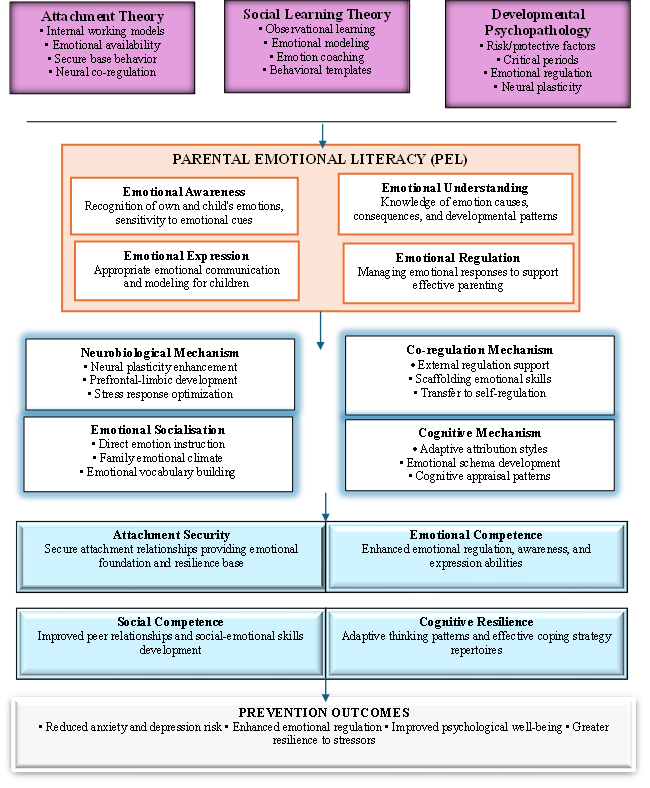
Anxiety and depression during the foundation phase of childhood (ages 5–8) present developmental concerns that may affect children's emotional well-being, social relationships, and educational experiences. This study aims to develop an integrative conceptual framework explaining how parental emotional literacy may function as a protective factor against anxiety and depression in foundation phase children. Using a conceptual approach, the study synthesizes theoretical and empirical literature through the integration of attachment theory, social learning theory, and developmental psychopathology. The conceptual synthesis identifies four interconnected dimensions of parental emotional literacy: emotional awareness, emotional understanding, emotional expression, and emotional regulation. These dimensions are theoretically linked to four mechanisms of influence: neurobiological development, parent–child co-regulation, emotional socialization, and cognitive development. The proposed framework further identifies attachment security, emotional competence, social competence, and cognitive resilience as protective pathways potentially associated with reduced vulnerability to anxiety and depression. The synthesis highlights how emotionally responsive parenting, supportive communication, emotional modeling, and guided regulation may contribute to children's psychological well-being and adaptive development. The study concludes that parental emotional literacy provides a theoretically grounded foundation for developing preventive approaches within families, early childhood education, and school-based parental support programs. However, the proposed relationships require further empirical validation through longitudinal and intervention-based research.
Downloads
##plugins.themes.bootstrap3.article.details##
Copyright (c) 2026 Judith Ngunan Age, Susan Thuketana

This work is licensed under a Creative Commons Attribution-ShareAlike 4.0 International License.
References
Alink, L. R., Cicchetti, D., Kim, J., & Rogosch, F. A. (2012). Longitudinal associations among child maltreatment, social functioning, and cortisol regulation. Developmental psychology, 48(1), 224–236. https://doi.org/10.1037/a0024892
Bandura, A. (1977). Social learning theory. Prentice-Hall.
Barry, C. T., Kim, H., & Halter, B. M. (2023). Developmental psychopathology. In J. L. Matson (Ed.), Handbook of clinical child psychology: Integrating theory and research into practice (pp. 19–34). Springer Nature Switzerland AG. https://doi.org/10.1007/978-3-031-24926-6_2.
Beardslee, W. R., Brent, D. A., Weersing, V. R., Clarke, G. N., Porta, G., Hollon, S. D., Gladstone, T. R., Gallop, R., Lynch, F. L., Iyengar, S., DeBar, L., & Garber, J. (2013). Prevention of depression in at-risk adolescents: longer-term effects. JAMA psychiatry, 70(11), 1161–1170. https://doi.org/10.1001/jamapsychiatry.2013.295
Bøe, T., Sivertsen, B., Heiervang, E., Goodman, R., Lundervold, A. J., & Hysing, M. (2014). Socioeconomic status and child mental health: the role of parental emotional well-being and parenting practices. Journal of abnormal child psychology, 42(5), 705–715. https://doi.org/10.1007/s10802-013-9818-9.
Bitsko, R. H., Claussen, A. H., Lichstein, J., Black, L. I., Jones, S. E., Danielson, M. L., Hoenig, J. M., Davis Jack, S. P., Brody, D. J., Gyawali, S., Maenner, M. J., Warner, M., Holland, K. M., Perou, R., Crosby, A. E., Blumberg, S. J., Avenevoli, S., Kaminski, J. W., & Ghandour, R. M. (2022). Mental health surveillance among children—United States, 2013–2019. MMWR Supplements, 71(2), 1–42. https://doi.org/10.15585/mmwr.su7102a1
Bowlby, J. (1969). Attachment and loss: Vol. 1. Attachment. Basic Books.
Bozicevic, L., Hill, J., Chandra, P. S., Omirou, A., Holla, C., Wright, N., & Sharp, H. (2023). Cross-cultural differences in early caregiving: levels of mind-mindedness and instruction in UK and India. Frontiers in child and adolescent psychiatry, 2, 1124883. https://doi.org/10.3389/frcha.2023.1124883
Bridgett, D. J., Burt, N. M., Edwards, E. S., & Deater-Deckard, K. (2015). Intergenerational transmission of self-regulation: A multidisciplinary review and integrative conceptual framework. Psychological Bulletin, 141(3), 602–654. https://doi.org/10.1037/a0038662.
Bridgett, D. J., Ganiban, J. M., Neiderhiser, J. M., Natsuaki, M. N., Shaw, D. S., Reiss, D., & Leve, L. D. (2018). Contributions of mothers' and fathers' parenting to children's self-regulation: Evidence from an adoption study. Developmental science, 21(6), e12692. https://doi.org/10.1111/desc.12692.
Cañas, M., Ibabe, I., Arruabarrena, I., & De Paúl, J. (2022). The dyadic parent-child interaction coding system (DPICS): Negative talk as an indicator of dysfunctional mother-child interaction. Children and Youth Services Review, 143, 106679. https://doi.org/10.1016/j.childyouth.2022.106679.
Calkins, S. D., & Hill, A. (2007). Caregiver Influences on Emerging Emotion Regulation: Biological and Environmental Transactions in Early Development. In J. J. Gross (Ed.), Handbook of emotion regulation (pp. 229–248). The Guilford Press..
Calkins, S. D., & Perry, N. B. (2016). The development of emotion regulation: Implications for child adjustment. In D. Cicchetti (Ed.), Developmental psychopathology: Maladaptation and psychopathology (3rd ed., pp. 187–242). John Wiley & Sons, Inc.. https://doi.org/10.1002/9781119125556.devpsy306
Coatsworth, J. D., Duncan, L. G., Nix, R. L., Greenberg, M. T., Gayles, J. G., Bamberger, K. T., Berrena, E., & Demi, M. A. (2015). Integrating mindfulness with parent training: effects of the Mindfulness-Enhanced Strengthening Families Program. Developmental psychology, 51(1), 26–35. https://doi.org/10.1037/a0038212.
Compas, B. E., Forehand, R., Thigpen, J. C., Keller, G., Hardcastle, E. J., Cole, D. A., Potts, J., Watson, K. H., Rakow, A., Colletti, C., Reeslund, K., Fear, J., Garai, E., McKee, L., Merchant, M. J., & Roberts, L. (2011). Family group cognitive-behavioral preventive intervention for families of depressed parents: 18- and 24-month outcomes. Journal of consulting and clinical psychology, 79(4), 488–499. https://doi.org/10.1037/a0024254
Compas, B. E., Jaser, S. S., Bettis, A. H., Watson, K. H., Gruhn, M. A., Dunbar, J. P., Williams, E., & Thigpen, J. C. (2017). Coping, emotion regulation, and psychopathology in childhood and adolescence: A meta-analysis and narrative review. Psychological bulletin, 143(9), 939–991. https://doi.org/10.1037/bul0000110
Costello, E. J., Copeland, W., & Angold, A. (2011). Trends in psychopathology across the adolescent years: what changes when children become adolescents, and when adolescents become adults? Journal of child psychology and psychiatry, and allied disciplines, 52(10), 1015–1025. https://doi.org/10.1111/j.1469-7610.2011.02446.x.
Cummings, E. M., Koss, K. J., & Davies, P. T. (2015). Prospective relations between family conflict and adolescent maladjustment: security in the family system as a mediating process. Journal of abnormal child psychology, 43(3), 503–515. https://doi.org/10.1007/s10802-014-9926-1.
Denham, S. A., Bassett, H. H., Mincic, M., Kalb, S., Way, E., Wyatt, T., & Segal, Y. (2012). Social-Emotional Learning Profiles of Preschoolers' Early School Success: A Person-Centered Approach. Learning and individual differences, 22(2), 178–189. https://doi.org/10.1016/j.lindif.2011.05.001.
Denham, S. A., Bassett, H. H., & Wyatt, T. (2015). The socialization of emotional competence. In J. E. Grusec & P. D. Hastings (Eds.), Handbook of socialization: Theory and research (2nd ed., pp. 590–613). The Guilford Press.
Denham, S. A., Bassett, H. H., & Wyatt, T. M. (2020). Preschool emotional competence: Pathway to social competence? Child Development Perspectives, 14(4), 239–246.
Denham, S. A., Kalb, S., Way, E., Warren-Khot, H., Rhoades, B. L., & Bassett, H. H. (2013). Social and emotional information processing in preschoolers: Indicator of early school success?. Early child development and care, 183(5), 667–688. https://doi.org/10.1080/03004430.2012.682728
Dunsmore, J. C., Her, P., Halberstadt, A. G., & Perez-Rivera, M. B. (2009). Parents' Beliefs about Emotions and Children's Recognition of Parents' Emotions. Journal of nonverbal behavior, 33(2), 121–140. https://doi.org/10.1007/s10919-008-0066-6
Durlak, J. A., Weissberg, R. P., Dymnicki, A. B., Taylor, R. D., & Schellinger, K. (2011). The impact of enhancing students’ social and emotional learning: A meta-analysis of school-based universal interventions. Child Development, 82, 405-432.
Gebre, Z. A., Demissie, M. M., & Yimer, B. M. (2025). The impact of teacher socio-emotional competence on student engagement: a meta-analysis. Frontiers in psychology, 16, 1526371. https://doi.org/10.3389/fpsyg.2025.1526371.
Gee, D. G., Gabard-Durnam, L. J., Flannery, J., Goff, B., Humphreys, K. L., Telzer, E. H., Hare, T. A., Bookheimer, S. Y., & Tottenham, N. (2013). Early developmental emergence of human amygdala-prefrontal connectivity after maternal deprivation. Proceedings of the National Academy of Sciences of the United States of America, 110(39), 15638–15643. https://doi.org/10.1073/pnas.1307893110.
Gottman, J. M., Katz, L. F., & Hooven, C. (1996). Parental meta-emotion philosophy and the emotional life of families: Theoretical Models and Preliminary Data. Journal of Family Psychology, 10(3), 243–268.
Gottman, J. M., Katz, L. F., & Hooven, C. (1997). Meta-emotion: How families communicate emotionally. Lawrence Erlbaum Associates.
Grüning Parache, L., Vogel, M., Meigen, C., Kiess, W., & Poulain, T. (2024). Family structure, socioeconomic status, and mental health in childhood. European child & adolescent psychiatry, 33(7), 2377–2386. https://doi.org/10.1007/s00787-023-02329-y
Groh, A. M., Fearon, R. P., Bakermans-Kranenburg, M. J., van Ijzendoorn, M. H., Steele, R. D., & Roisman, G. I. (2014). The significance of attachment security for children's social competence with peers: a meta-analytic study. Attachment & human development, 16(2), 103–136. https://doi.org/10.1080/14616734.2014.883636.
Havighurst, S. S., Ambrosi, C. C., Harley, A. E., & Kehoe, C. E. (2025). Tuning in to Kids: Theoretical basis, program description, and factors impacting effectiveness. Journal of Applied Developmental Psychology, 98, 101797. https://doi.org/10.1016/j.appdev.2025.101797
Havighurst, S. S., Duncombe, M., Frankling, E., Holland, K., Kehoe, C., & Stargatt, R. (2015). An emotion-focused early intervention for children with emerging conduct problems. Journal of abnormal child psychology, 43(4), 749–760. https://doi.org/10.1007/s10802-014-9944-z
Havighurst, S. S., Kehoe, C. E., & Harley, A. E. (2015). Tuning in to teens: Improving parental responses to anger and reducing youth externalizing behavior problems. Journal of Adolescence, 42, 148–158. https://doi.org/10.1016/j.adolescence.2015.04.005.
Jaakkola, E. (2020). Designing conceptual articles: Four approaches. AMS Review, 10(1–2), 18–26. https://doi.org/10.1007/s13162-020-00161-0
Kerr, K. L., Ratliff, E. L., Cosgrove, K. T., Bodurka, J., Morris, A. S., & Kyle Simmons, W. (2019). Parental influences on neural mechanisms underlying emotion regulation. Trends in neuroscience and education, 16, 100118. https://doi.org/10.1016/j.tine.2019.100118
Kim, J., Suh, W., Kim, S., & Gopalan, H. (2012). Coping strategies to manage acculturative stress: meaningful activity participation, social support, and positive emotion among Korean immigrant adolescents in the USA. International journal of qualitative studies on health and well-being, 7, 1–10. https://doi.org/10.3402/qhw.v7i0.18870.
Laakso, M., Fagerlund, Å., Westerlund-Cook, S., Ristolainen, H., Niemelä, M., & Solantaus, T. (2023). Enhancing mindfulness, emotional well-being and strengths in parenting via an eight-week Flourishing Families intervention. Journal of Child and Family Studies, 32(8), 2375–2393. https://doi.org/10.1007/s10826-023-02618-9
Lorthe, E., Richard, V., Dumont, R., Loizeau, A., Perez-Saez, J., Baysson, H., Zaballa, M. E., Lamour, J., Pullen, N., Schrempft, S., Barbe, R. P., Posfay-Barbe, K. M., Guessous, I., Stringhini, S., & SEROCoV-KIDS study group (2023). Socioeconomic conditions and children's mental health and quality of life during the COVID-19 pandemic: An intersectional analysis. SSM - population health, 23, 101472. https://doi.org/10.1016/j.ssmph.2023.101472
Luby, J. L., Baram, T. Z., Rogers, C. E., & Barch, D. M. (2020). Neurodevelopmental Optimization after Early-Life Adversity: Cross-Species Studies to Elucidate Sensitive Periods and Brain Mechanisms to Inform Early Intervention. Trends in neurosciences, 43(10), 744–751. https://doi.org/10.1016/j.tins.2020.08.001.
Lunkenheimer, E., Hamby, C. M., Lobo, F. M., Cole, P. M., & Olson, S. L. (2020). The role of dynamic, dyadic parent-child processes in parental socialization of emotion. Developmental psychology, 56(3), 566–577. https://doi.org/10.1037/dev0000808.
Madigan, S., Atkinson, L., Laurin, K., & Benoit, D. (2013). Attachment and internalizing behavior in early childhood: A meta-analysis. Developmental Psychology, 49(4), 672–689. https://doi.org/10.1037/a0028793.
Martínez-Priego, C., García-Noblejas, B. P., & Roca, P. (2024). Strategies and goals in Emotion Regulation models: a systematic review. Frontiers in psychology, 15, 1425465. https://doi.org/10.3389/fpsyg.2024.1425465.
Masten, A. S., & Motti-Stefanidi, F. (2020). Multisystem Resilience for Children and Youth in Disaster: Reflections in the Context of COVID-19. Adversity and resilience science, 1(2), 95–106. https://doi.org/10.1007/s42844-020-00010-w.
McKay, M. M., Sensoy Bahar, O., & Ssewamala, F. M. (2020). Implementation science in global health settings: Collaborating with governmental & community partners in Uganda. Psychiatry research, 283, 112585. https://doi.org/10.1016/j.psychres.2019.112585
Morris, A. S., Cui, L., Jespersen, J. E., Criss, M. M., & Cosgrove, K. T. (2022). Parenting and children’s social and emotional development: Emotion socialization across childhood and adolescence. In A. S. Morris & J. M. Smith (Eds.), The Cambridge handbook of parenting (pp. 71–94). Cambridge University Press. https://doi.org/10.1017/9781108891400.006.
Morris, A. S., Robinson, L. R., Hays-Grudo, J., Claussen, A. H., Hartwig, S. A., & Treat, A. E. (2017). Targeting Parenting in Early Childhood: A Public Health Approach to Improve Outcomes for Children Living in Poverty. Child development, 88(2), 388–397. https://doi.org/10.1111/cdev.12743.
Muris, P., & Broeren, S. (2022). Childhood anxiety and depression: A developmental psychopathology perspective. Journal of Affective Disorders, 300, 212–218.
Nimphy, C. A., Venetikidi, M., Elzinga, B., Van der Does, W., & Aktar, E. (2023). Parent to offspring fear transmission via modeling in early life: A systematic review and meta-analysis. Clinical child and family psychology review, 26(3), 751-772.
Price, N. N., & Kiel, E. J. (2022). Longitudinal links among mother and child emotion regulation, maternal emotion socialization, and child anxiety. Research on Child and Adolescent Psychopathology, 50(2), 241–254. https://doi.org/10.1007/s10802-021-00804-1
Proctor, E. K., Landsverk, J., Aarons, G., Chambers, D., Glisson, C., & Mittman, B. (2009). Implementation research in mental health services: An emerging science with conceptual, methodological, and training challenges. Administration and Policy in Mental Health and Mental Health Services Research, 36(1), 24–34. https://doi.org/10.1007/s10488-008-0197-4
Psychogiou, L., Moberly, N. J., Parry, E., Nath, S., Kallitsoglou, A., & Russell, G. (2017). Parental depressive symptoms, children's emotional and behavioural problems, and parents' expressed emotion-Critical and positive comments. PloS one, 12(10), e0183546. https://doi.org/10.1371/journal.pone.0183546
Racine, N., McArthur, B. A., Cooke, J. E., et al. (2021). Global prevalence of depressive and anxiety symptoms in children and adolescents during COVID-19: A meta-analysis. JAMA Pediatrics, 175(11), 1142–1150.
Sahle, B. W., Reavley, N. J., Li, W., Morgan, A. J., Yap, M. B. H., Reupert, A., & Jorm, A. F. (2022). The association between adverse childhood experiences and common mental disorders and suicidality: an umbrella review of systematic reviews and meta-analyses. European child & adolescent psychiatry, 31(10), 1489-1499.
Sanders, M. R., Kirby, J. N., Tellegen, C. L., & Day, J. J. (2014). The Triple P-Positive Parenting Program: a systematic review and meta-analysis of a multi-level system of parenting support. Clinical psychology review, 34(4), 337–357. https://doi.org/10.1016/j.cpr.2014.04.003.
Sandler, I., Ingram, A., Wolchik, S., Tein, J. Y., & Winslow, E. (2015). Long-Term Effects of Parenting-Focused Preventive Interventions to Promote Resilience of Children and Adolescents. Child development perspectives, 9(3), 164–171. https://doi.org/10.1111/cdep.12126.
Santana-Ferrándiz, M., Ibáñez-Pérez, J., & Moret-Tatay, C. (2025). Empathy and Parental Sensitivity in Child Attachment and Socioemotional Development: A Systematic Review from Emotional, Genetic, and Neurobiological Perspectives. Children, 12(4), 465. https://doi.org/10.3390/children12040465.
Spinrad, T. L., & Eisenberg, N. (2024). The socialization of emotion regulation. In J. J. Gross & B. Q. Ford (Eds.), Handbook of emotion regulation (3rd ed., pp. 129–135). The Guilford Press.
Spruit, A., Goos, L., Weenink, N., Rodenburg, R., Niemeyer, H., Stams, G. J., & Colonnesi, C. (2020). The relation between attachment and depression in children and adolescents: A multilevel meta-analysis. Clinical Child and Family Psychology Review. https://doi.org/10.1007/s10567-019-00299-9
Weist, M. D., Hoover, S. A., Daly, B. P., Short, K. H., & Bruns, E. J. (2023). Propelling the Global Advancement of School Mental Health. Clinical child and family psychology review, 26(4), 851–864. https://doi.org/10.1007/s10567-023-00434-7.
World Health Organization. (2023). Mental health atlas 2023.
Zelazo, P. D., Blair, C. B., & Willoughby, M. T. (2016). Executive function: Implications for Education (NCER 2017-2000). National Center for Education Research, Institute of Education Sciences, US Department of Education