
Educating Children in Crisis: Adaptive Islamic Curricula as Drivers of Transitional Justice in Nigeria, Somalia, and the Sahel
##plugins.themes.bootstrap3.article.sidebar##
##plugins.themes.bootstrap3.article.main##
 Tri Wahyudi Ramdhan
 https://orcid.org/0000-0002-1690-4835
Luluk Alfiya
https://orcid.org/0000-0002-1690-4835
Luluk Alfiya
 Mowafg Abrahem Masuwd
https://orcid.org/0000-0002-2303-5244
Makherus Sholeh
https://orcid.org/0000-0002-2591-5253
Moh. Amiril Mukminin
https://orcid.org/0009-0004-1354-2260
Mowafg Abrahem Masuwd
https://orcid.org/0000-0002-2303-5244
Makherus Sholeh
https://orcid.org/0000-0002-2591-5253
Moh. Amiril Mukminin
https://orcid.org/0009-0004-1354-2260
Abstract
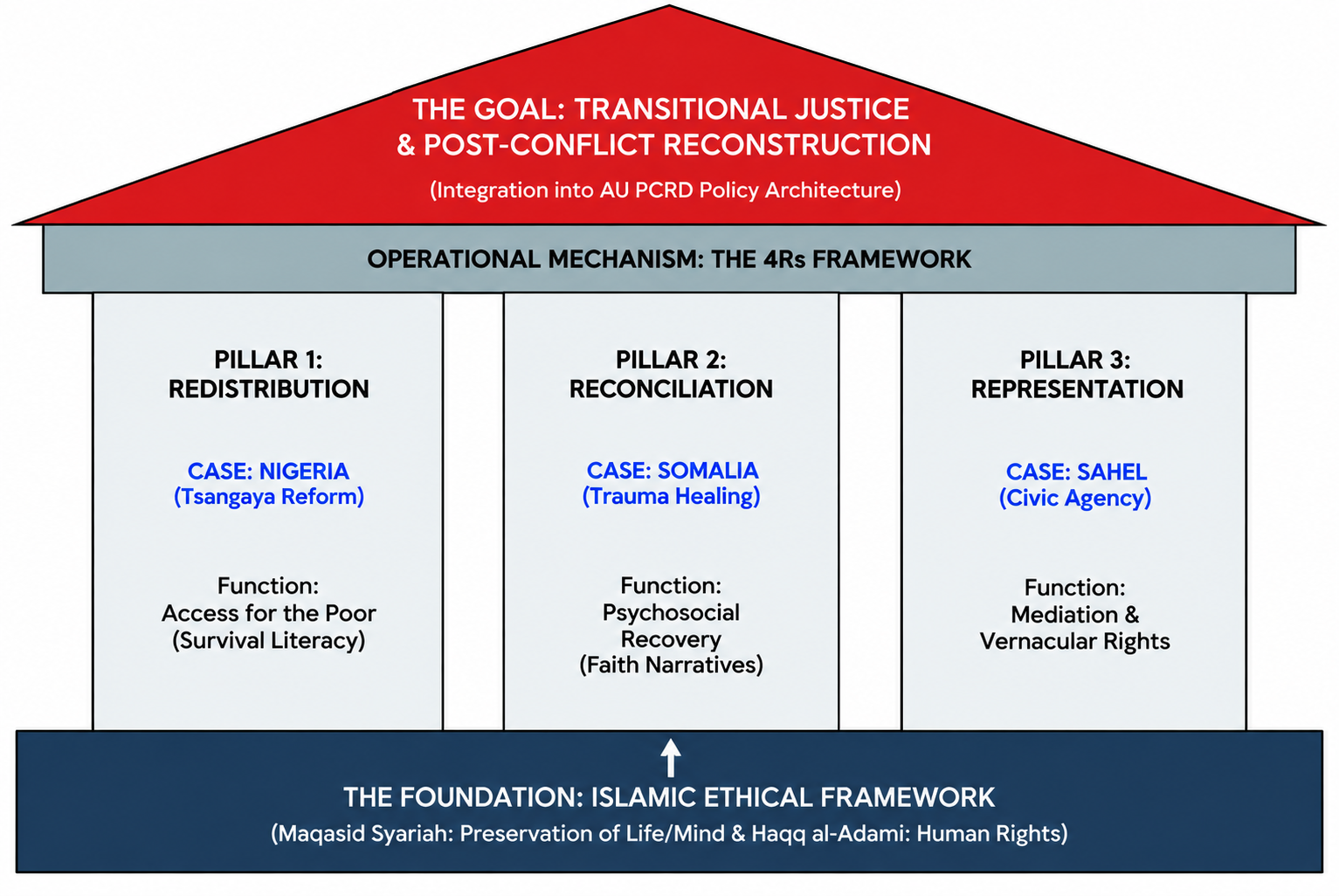
Prolonged conflict in Sub-Saharan Africa has disrupted formal schooling for millions of children aged 6–18 years, threatening educational continuity and their cognitive, social, and emotional development. Despite their continued presence in conflict-affected communities, local Islamic educational institutions remain insufficiently examined within Education in Emergencies and the Humanitarian-Development-Peace Nexus. This study aims to examine how adaptive Islamic curricula support conflict-affected children and contribute to transitional justice in Nigeria, Somalia, and the Sahel. Using Qualitative Document Analysis, 42 strategically selected documents published between 2015 and 2025, comprising humanitarian reports from UNICEF, UNESCO, and the World Bank and peer-reviewed academic case studies, were triangulated and analysed through deductive thematic coding using a standardized 4R Framework codebook encompassing Redistribution, Recognition, Representation, and Reconciliation. The findings identify three context-specific mechanisms. In Nigeria, hybrid Tsangaya curricula promote Redistribution by integrating basic literacy into traditional learning and expanding access to education for disadvantaged, conflict-affected children. In Somalia, adaptations of Aqidah and Akhlaq pedagogy foster Reconciliation through prophetic narratives that support trauma healing and cognitive-emotional stability. In the Sahel, religious educators strengthen Representation by translating universal human rights concepts into vernacular Fiqh frameworks for community dispute mediation. These findings demonstrate that adaptive Islamic curricula function not merely as alternative schooling but as grassroots educational “survival infrastructure” linking learning continuity, psychosocial recovery, and locally grounded justice practices. The study therefore proposes Faith-Based Transitional Justice as a context-sensitive framework for strengthening post-conflict child education policy and practice.
Downloads
##plugins.themes.bootstrap3.article.details##
Copyright (c) 2026 Tri Wahyudi Ramdhan, Luluk Alfiya, Mowafg Abrahem Masuwd, Makherus Sholeh, Moh. Amiril Mukminin

This work is licensed under a Creative Commons Attribution-ShareAlike 4.0 International License.
References
Action, F. F. to. (2020). FAITH-BASED AND INTER-RELIGIOUS ACTORS TO PROTECT REFUGEE AND (Number December).
Adan, M. Y. (2025). The role of peace education in promoting social justice and sustainable peace in post-conflict societies: A 4Rs framework analysis. Frontiers in Political Science. https://doi.org/10.3389/fpos.2025.1650027
Alasso, M. M., Ahmed, A. M., & Mohamud, A. O. (n.d.). Learning from Rwanda: How post-conflict education for peace can inform Somalia’s peacebuilding process. Researchgate.Net. Retrieved https://www.researchgate.net/profile/Amina-Mohamud/publication/398939051_Learning_from_Rwanda_How_post_conflict_education_for_peace_can_inform_Somalia’s_peacebuilding_process/links/6949279e0c98040d481fd540/Learning-from-Rwanda-How-post-conflict-education-
Ali, M., Mutavi, T., Mburu, J. M., & Mathai, M. (2023). Prevalence of Posttraumatic Stress Disorder and Depression Among Internally Displaced Persons in Mogadishu-Somalia. Neuropsychiatric Disease and Treatment, 19, 469–478. https://doi.org/10.2147/NDT.S398423
Bano, M. (2009). Engaged yet disengaged: Islamic schools and the state in Kano, Nigeria. epapers.bham.ac.uk. http://epapers.bham.ac.uk/1568
Barrios-tao, H., & Bonilla-barrios, B. (2017). Education Programs in Post-Conflict Environments : a Review from Liberia , Sierra Leone , and South Africa 1. 21(1), 1–22.
Bashar, T. A. (2025). Global Academic Journal of Linguistics and Literature An Appraisal of the Role of Qur ’ anic and Madrasa Education in the Sokoto Caliphate. 9028, 10–13.
Bentley, J. A., Feeny, N. C., Dolezal, M. L., Klein, A., Marks, L. H., Graham, B., & Zoellner, L. A. (2021). Islamic Trauma Healing: Integrating Faith and Empirically Supported Principles in a Community-Based Program. Cognitive and Behavioral Practice, 28(2). https://doi.org/10.1016/j.cbpra.2020.10.005
Blackmer, G., & Akila, Y. A. (2024). Conflicts in Northern Nigeria and the role of (inter-) religious education in peacebuilding. African Journal of Religious and …. http://afropolitanjournals.com/index.php/ajrts/article/view/545
Bleck, J. (2015). Education and empowered citizenship in Mali. JHU Press. https://books.google.com/books?hl=en&lr=&id=BGFjCgAAQBAJ&oi=fnd&pg=PP1&ots=G4GH411ovk&sig=pwyzbQzFRG_COrK3M5NeuUV2PfI
Bowen, G. A. (2009). Document analysis as a qualitative research method. Qualitative Research Journal, 9(2), 27–40. https://doi.org/10.3316/QRJ0902027
Brenner, L. (2007). The transformation of Muslim schooling in Mali: The madrasa as an institution of social and religious mediation. Schooling Islam: The Culture and Politics of Modern …. https://books.google.com/books?hl=en%5C&lr=%5C&id=h2SYDwAAQBAJ%5C&oi=fnd%5C&pg=PA199%5C&dq=%22islamic+education%22%7Cmadrasa+conflict%7C%22post+conflict%22+nigeria%7Csomalia%7Cmali%7Csudan%7Csahel%7C%22boko+haram%22%7C%22al+shabaab%22%5C&ots=fr__b2KOmj%5C
Deja, R. (2000). Conflict Analysis. In The PBEA programme (Number June, pp. 491–519). https://doi.org/10.1007/978-3-7908-1840-6_9
Demarest, L., Godefroidt, A., & Langer, A. (2020). Understanding news coverage of religious-based violence: Empirical and theoretical insights from media representations of Boko Haram in Nigeria. Journal of Communication. https://doi.org/10.1093/joc/jqaa011/33560940/jqaa011
Grace, G., & Wodon, Q. (2022). Catholic and Faith-Based Schools in Africa: Introduction to the Special Issue. In Catholic and Faith-Based Schools in Africa: Introduction to the Special Issue. https://doi.org/10.1596/37006
Gwaza, A. P., & Ochogwu, J. (2024). Building Inclusive Religious Education in Nigeria. SSRN Electronic Journal. https://doi.org/10.2139/ssrn.4947012
Hoechner, H. (2025). Islamic education in northern Nigeria. Religionspädagogische Beiträge. https://rpb-journal.de/index.php/rpb/article/view/1920
Hoechner, H., Bukar, Y., Galadima, A., & ... (2025). Exploring the nexus between Islamic education and violent conflict: Qur’anic schools and the Boko Haram insurgency in northeast Nigeria. Comparative Education …. https://ueaeprints.uea.ac.uk/id/eprint/100691/
Horn, N. (2004). Human rights education in Africa Introduction: Human rights education in the context of the United Nations. 55(January 1995), 53–78.
Johnson, D., Phillips, D., & Maclean, R. (2007). Education for Livelihoods and Civic Participation in Post-Conflict Countries Conceptualizing a Holistic Approach To Tvet Planning and Programming in Sub-Saharan Africa. 37. https://unevoc.unesco.org/fileadmin/user_upload/pubs/IntLib_DiscP_PostConf.pdf
Lateef, R. A., & Paramole, K. O. (2024). Reappraising Islamic Moral Education for Positive Nationhood in Nigeria. Journal of Religions and Peace Studies. https://oa.unij.co.uk/index.php/joreps/article/view/12
Launay, R. (2018). Islamic Education in Africa. In Islamic Education in Africa. Indiana University Press. https://doi.org/10.2307/j.ctt1zxz0gv
Maclean, R., Felix Rauner, P., Karen Evans, P., Atchoarena, D., Benteler, P., Bremen, S., Diane Booker, G., John Budu-Smith, A., De Moura Castro, C., Pitágoras, F., Horizonte, B., Wendy Duncan, B., Development Bank, A., Michael Frearson, P., Gasperini, L., Grubb, N., Herschbach, D. R., Phillip Hughes, P., Kerre, B. W., … Wurdak, A. (2009). International Handbook of Education for the Changing World of Work (R. Maclean & D. Wilson, Eds.). Springer Science & Business Media.
Mopan Assessment Report. (2021). MOPAN Assessment Report United Nations Children ’ s Fund ( UNICEF ). (September).
Murugaiah, K. (2023). “We make do”: Experiences and beliefs of teachers working in conflict-affected Niger. International Journal of Educational Development. https://www.sciencedirect.com/science/article/pii/S0738059323000846
Newman, A. (2019). Islamic education in Africa: writing boards and blackboards. Compare: A Journal of Comparative and International Education, 49(6), 1010–1012. https://doi.org/10.1080/03057925.2018.1543156
Novelli, M. (2017). Education and countering violent extremism: Western logics from south to north? Compare: A Journal of Comparative and International …. https://doi.org/10.1080/03057925.2017.1341301
Novelli, M., Lopes Cardozo, M. T. A., & Smith, A. (2017). The 4RS Framework: Analyzing Education’s Contribution to Sustainable Peacebuilding with Social Justice in Conflict-Affected Contexts. JOURNAL ON EDUCATION IN EMERGENCIES Source: Journal on Education in Emergencies¸VolEmergencies¸Vol, 3(1), 14–43. https://doi.org/10.17609/N8S94K
Oliver, J. (2019). Policy on POst-Conflict Reconstruction and Development. African Union, 1, 1–476.
Paffenholz, T. (2021). Perpetual Peacebuilding: A New Paradigm to Move Beyond the Linearity of Liberal Peacebuilding. Journal of Intervention and Statebuilding, 15(3), 367–385. https://doi.org/10.1080/17502977.2021.1925423
Paulson, J. (2009). (Re)Creating Education in Postconflict Contexts: Transitional Justice, Education, and Human Development. Human Development, (November), 1–32.
PCRD. (2025). African Union ’ s Policy on Post-Conflict Reconstruction and Development. (June 2006), 1–12.
Peters, M. A. (2014). ‘Western Education is Sinful’: Boko Haram and the Abduction of Chibok Schoolgirls. Policy Futures in Education, 12(2), 186–190. https://doi.org/10.2304/PFIE.2014.12.2.186
Price, R. (2019). Lessons learned from education programmes’ contribution to peace and stability. https://gsdrc.org/
Salad, A. M., Malik, S., Ndithia, J. M., Noor, Z., & ... (2023). Prevalence of mental disorders and psychological trauma among conflict-affected population in Somalia: a cross-sectional study. Frontiers in Public …. https://doi.org/10.3389/fpubh.2023.1219992
Tahir, A. I., & Cochrane, L. (2025). Dynamics of education in post-conflict Somalia: the case of out-of-school children in Mogadishu. SN Social Sciences. https://doi.org/10.1007/s43545-025-01123-8
Tamari, T. (2016). Styles of Islamic education: perspectives from Mali, Guinea, and the Gambia. Islamic Education in Africa: Writing Boards and …. https://shs.hal.science/halshs-03837413/
Thurston, A. (2016). Colonial control, Nigerian agency, Arab outreach and Islamic education in northern Nigeria, 1900-1966. Islamic Education in Africa: Writing Boards and …. https://books.google.com/books?hl=en%5C&lr=%5C&id=t5ZNDQAAQBAJ%5C&oi=fnd%5C&pg=PA119%5C&dq=%22islamic+education%22%7Cmadrasa+conflict%7C%22post+conflict%22+nigeria%7Csomalia%7Cmali%7Csudan%7Csahel%7C%22boko+haram%22%7C%22al+shabaab%22%5C&ots=JDPENDlXvc%5C
Thurston, A. (2017). Jihadist Movement, Princeton: Princeton University Press, ISBN 978 0691172248, 333 pp. Alexander Thurston’s Boko Haram: The History of an African Jihadist …. Africa Spectrum. https://journals.sub.uni-hamburg.de/giga/afsp/article/viewPDFInterstitial/1085/1092
Tibbitts, F., Moustafa, Y., Fomekong, S. T., Bouare, F., Francois, L., & Vallée, J. (2024). HUMAN RIGHTS EDUCATION IN SITUATIONS OF CONFLICT : SURVEY REPORT. 1–25.
UNICEF. (2016). The State of the World’s Children 2016 A fair chance for every child. In Materials Letters (Vol. 2, Number 6). https://www.unicef.org/reports/state-worlds-children-2016
UNICEF. (2021a). Formative Evaluation of UNICEF Work to Link Humanitarian and Development Programming (Number March). https://www.unicef.org/evaluation/reports#/detail/17156/evaluation-of-unicefs- work-to-link-humanitarian-and-development-programming UNICEF.
UNICEF. (2021b). Summary of UNICEF ’ s Education Results.
UNICEF. (2023). UNICEF Peacebuilding Programming Framework. UNICEF.
Unicef Innocenti. (2024). Improving Education in Africa.
Usman, A., Maina, Y. B., & Mohammed, H. (2022). … IN MANDARAGIRAU DISTRICT, BIU LOCAL GOVERNMENT, BORNO STATE, NIGERIA: EFFECT OF BOKO HARAM/ISWAP CONFLICT ON HUMAN AND …. CEDS Journal of …. https://cedsjournal.com/home/articles/volume3/CEDS_JEIR6479E7588A3AC_EFFECT_OF_BOKO_HARAM.pdf
Vigne, J., Cocco, K., & Pfister, B. K. (2022). 25 YEARS OF CHILDREN AND ARMED CONFLICT : TAKING ACTION TO PROTECT CHILDREN IN WAR. United Nations Children’s Fund (UNICEF).
Williams, J. H., & Cummings, W. C. (2018). Education from the Bottom Up: UNICEF’s Education Programme in Somalia. In Development Assistance for Peacebuilding (pp. 137–152). Routledge. https://doi.org/10.4324/9781315113289-8
World Bank, UNESCO, & UNICEF. (2021). The state of the global education crisis: a path to recovery. In The state of the global education crisis: a path to recovery. https://doi.org/10.54675/jlug7649