
Developing Mathematical Creativity in Early Grades: Impact Analysis of Geometric Problem Solving on Student Cognitive Levels
##plugins.themes.bootstrap3.article.sidebar##
##plugins.themes.bootstrap3.article.main##
 Ani Afifah
 https://orcid.org/0000-0002-3925-1208
 Samuel Karim
Abstract
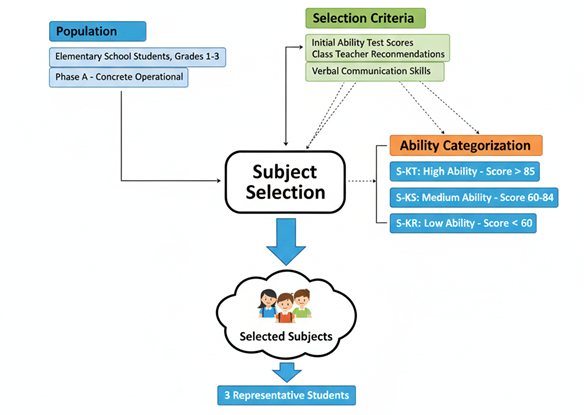
In today's digital era, critical and creative thinking skills are crucial for students to adapt to the demands of the 21st century. Creative and effective teaching, such as geometric problem solving, is considered an attractive strategy to enhance these skills. This study was conducted to evaluate the impact of geometric problem solving teaching on students' cognitive development at the elementary level, where previous research has focused more on the development of cognitive and psychomotor skills. The main objective of this study was to analyze the level of mathematical creativity of early grade students in solving geometric problems involving triangles and quadrilaterals. Using a qualitative descriptive approach, this study involved three students with different levels of mathematical ability. Data were collected through validated problem-solving tasks, in-depth interviews, and documentation, then analyzed based on indicators of fluency, flexibility, originality, and elaboration. The results showed significant differences in students' cognitive levels: students with high ability achieved Creative Thinking Level (CTL) 4, students with medium ability achieved CTL 2, and students with low ability achieved CTL 0. The integration of non-routine geometric problems from the early grades is crucial for mapping and stimulating students' creative potential. These findings provide practical implications for educators in designing inclusive learning interventions to accelerate the achievement of basic numeracy literacy and 21st-century skills in accordance with the global mandate of the SDGs.
Downloads
##plugins.themes.bootstrap3.article.details##
Copyright (c) 2025 Ani Afifah, Samuel Karim

This work is licensed under a Creative Commons Attribution-ShareAlike 4.0 International License.
References
Afifah, A., Ainiyah, D., & Dehham, S. H. (2024). Interactive Digital Media PanPinRu as an Effort to Increase Interest in Learning Students in Linear Equations of One Variable, 2(December), 185–188.
Baiduri, B. (2020). Students’ strategy in connecting fractions, decimal, and percent in solving visual form problems. Universal Journal of Educational Research, 8(11), 5361–5366. http://doi.org/10.13189/ujer.2020.081138
Botting, N. (2020). Language, literacy and cognitive skills of young adults with developmental language disorder (DLD). International Journal of Language and Communication Disorders, 55(2), 255–265. http://doi.org/10.1111/1460-6984.12518
Cheung, S. K. (2022). The roles of different executive functioning skills in young children’s mental computation and applied mathematical problem-solving. British Journal of Developmental Psychology, 40(1), 151–169. http://doi.org/10.1111/bjdp.12396
Chevalier, M. (2020). Fostering computational thinking through educational robotics: a model for creative computational problem solving. International Journal of Stem Education, 7(1). http://doi.org/10.1186/s40594-020-00238-z
Darmayanti, R., In, A., Afifah, A., Verliana, A., & Nurmaltasari, D. (2023). Analysis of the Need for Pizzaluv- Math Learning Media So that Students Can Easily Learn the Limits of Trigonometric Functions, 1(3), 211–220.
Deng, L. (2020). Digital game-based learning in a Shanghai primary-school mathematics class: A case study. Journal of Computer Assisted Learning, 36(5), 709–717. http://doi.org/10.1111/jcal.12438
Essel, H. B. (2024). ChatGPT effects on cognitive skills of undergraduate students: Receiving instant responses from AI-based conversational large language models (LLMs). Computers and Education Artificial Intelligence, 6. http://doi.org/10.1016/j.caeai.2023.100198
Facciaroni, L., Gambini, A., & Mazza, L. (2023). The difficulties in geometry: A quantitative analysis based on results of mathematics competitions in Italy. European Journal of Science and Mathematics Education, 11(2), 259–270. http://doi.org/10.30935/scimath/12590
Ferguson, T. (2020). SDG 4 in higher education: challenges and opportunities. International Journal of Sustainability in Higher Education, 21(5), 959–975. http://doi.org/10.1108/IJSHE-12-2019-0353
Filippetti, V. A. (2020). A hierarchical model of cognitive flexibility in children: Extending the relationship between flexibility, creativity and academic achievement. Child Neuropsychology, 26(6), 770–800. http://doi.org/10.1080/09297049.2019.1711034
Hasanah, S. (2023). Building Students’ Creative Thinking Ability Through STEM Integrated Project-Based Learning with Formative Assessment on Thermodynamics Topics. Aip Conference Proceedings, 2569. http://doi.org/10.1063/5.0112511
Kristiantari, M. G. R., Widiana, I. W., & Artawan, G. (2023). Enhancing the ability to write poetry and creative thinking skills with rural nature-inspired contextual approach. International Journal of Evaluation and Research in Education, 12(2), 761–770. http://doi.org/10.11591/ijere.v12i2.23194
Masykur, A. D. A., Haris, A., & Yazid, S. (2025). Strengthening Character Through Strengthening the Pancasila Student Profile (P5) and Rahmatan lil Alamin Student Profile (P2RA) at MA Muhammadiyah 1 Malang City. INTERNATIONAL JOURNAL OF SOCIAL SCIENCE AND EDUCATION RESEARCH STUDIES, 5(6). http://doi.org/10.55677/ijssers/v05i06y2025-11
Meadows, M., & Caniglia, J. (2021). That Was Then… This Is Now: Utilizing the History of Mathematics and Dynamic Geometry Software. International Journal of Education in Mathematics …. Retrieved from https://eric.ed.gov/?id=EJ1293194
Pathuddin. (2024). Students’ Polya Problem Solving Skills on System of Linear Equations with Two Variables Bases on Mathematical Ability. Aip Conference Proceedings, 3046(1). http://doi.org/10.1063/5.0194577
Patston, T. J., Kennedy, J. P., Jaeschke, W., Kapoor, H., Leonard, S. N., Cropley, D. H., & Kaufman, J. C. (2021). Secondary Education in COVID Lockdown: More Anxious and Less Creative—Maybe Not? Frontiers in Psychology, 12. http://doi.org/10.3389/fpsyg.2021.613055
Prioste, C. (2020). Teachers hypotheses on academic failure in the early grades of elementary school. Educacao E Pesquisa, 46. http://doi.org/10.1590/S1678-4634202046220336
Purnomo, H. (2022). Development of Instrument Numeracy Skills Test of Minimum Competency Assessment (MCA) in Indonesia. International Journal of Instruction, 15(3), 635–648. http://doi.org/10.29333/iji.2022.15335a
Qomaria, N., Afifah, A., & Manivannan, R. (2025). Identification of Junior High School Students â€TM Experiences in Using Question Card Media for Algebra Learning, 3(April), 7–10.
Rahardjanto, A., Husamah, H., & Fauzi, A. (2019). Hybrid-PjBL: Learning Outcomes, Creative Thinking Skills, and Learning Motivation of Preservice Teacher. International Journal of Instruction, 12(2), 179–192. http://doi.org/10.29333/iji.2019.12212a
Rati, N. W. (2023). HOTS-Oriented e-Project-Based Learning: Improving 4C Skills and Science Learning Outcome of Elementary School Students. International Journal of Information and Education Technology, 13(6), 959–968. http://doi.org/10.18178/ijiet.2023.13.6.1892
Sánchez-Gómez, J. S. (2023). SDG 4 on Quality Education in Colombia between 2019 and 2021. Proceedings of the Laccei International Multi Conference for Engineering Education and Technology, 2023. Retrieved from https://www.scopus.com/inward/record.uri?partnerID=HzOxMe3b&scp=85172363767&origin=inward
Simatupang, A., & Azis, Z. (2022). The Effect of Realistic Mathematics Learning Models with a JIGSAW Cooperative setting on Problem Solving abilities and Creative Thinking abilities of High School …. JMEA: Journal of Mathematics Education …. Retrieved from https://jurnal.umsu.ac.id/index.php/mtika/article/view/9164
Siswanto, D. H., Tanikawa, K., Alghiffari, E. K., Limori, M., & ... (2024). A Systematic Review: Use of GeoGebra in Mathematics Learning at Junior High School in Indonesia and Japan. J. Pendidik …. Retrieved from https://www.researchgate.net/profile/Deny-Hadi-Siswanto/publication/381653454_A_Systematic_Review_Use_of_GeoGebra_in_Mathematics_Learning_at_Junior_High_School_in_Indonesia_and_Japan/links/6678f14c1dec0c3c6f9f9410/A-Systematic-Review-Use-of-GeoGebra-in-Mathematics-Learning-at-Junior-High-School-in-Indonesia-and-Japan.pdf
Sohaeir, U., Azman, M. N. A., Hosshan, H., Othman, M. S., & Evans, D. G. (2023). Development of Easy Match as a Teaching Aid for Students of the Integration Special Education Program (Learning Problems) in Form One Basic Cooking Subjects at SMK Telok Gadong, Klang. Journal of Advanced Research in Applied Sciences and Engineering Technology, 31(2), 310–319. http://doi.org/10.37934/araset.31.2.310319
Suherman, S. (2024). MathematicalCreative Thinking-Ethnomathematics based Test: Role of Attitude toward Mathematics, Creative Style, Ethnic Identity, and Parents’ Educational Level. Revista De Educacion A Distancia, 24(77). http://doi.org/10.6018/red.581221
Sujiva, S., Thanaboonpuang, P., Laosum, T., Ingchatcharoen, S., Simpol, W., & Prathumthai, A. (2020). Cognitive skills of secondary school students: A tentative model and an online test. Kasetsart Journal of Social Sciences, 41(3), 598–603. http://doi.org/10.34044/j.kjss.2020.41.3.23
Tatto, M. T. (2021). Comparative research on teachers and teacher education: global perspectives to inform UNESCO’s SDG 4 agenda. Oxford Review of Education, 47(1), 25–44. http://doi.org/10.1080/03054985.2020.1842183
Toheri. (2020). Where exactly for enhance critical and creative thinking: The use of problem posing or contextual learning. European Journal of Educational Research, 9(2), 877–887. http://doi.org/10.12973/eu-jer.9.2.877
Verster, J. (2020). Constraints influencing the efficacy of a PGCE mathematics program: A case study. Alberta Journal of Educational Research, 66(2), 192–206. Retrieved from https://www.scopus.com/inward/record.uri?partnerID=HzOxMe3b&scp=85091184116&origin=inward
Wang, Y. (2022). On the recent proof of goldbach conjecture: from euclidean prime factorization to mirror prime decompositions of even integers in number theory (keynote). … Int’l Conference on Mathematics and Computers in …. Retrieved from https://www.researchgate.net/profile/Yingxu-Wang-3/publication/362226921_On_the_Recent_Proof_of_Goldbach_Conjecture_From_Euclidean_Prime_Factorization_to_Mirror_Prime_Decompositions_of_Even_Integers_in_Number_Theory_Keynote/links/63a4a28f097c7832ca591786/On-the-Recent-Proof-of-Goldbach-Conjecture-From-Euclidean-Prime-Factorization-to-Mirror-Prime-Decompositions-of-Even-Integers-in-Number-Theory-Keynote.pdf
Wark, L. (1992). Qualitative Research Journals. The Qualitative Report. http://doi.org/10.46743/2160-3715/1992.2039
Wijaya, T. T. (2021). Improving the Creative Thinking Skills of the Next Generation of Mathematics Teachers Using Dynamic Mathematics Software. International Journal of Emerging Technologies in Learning, 16(13), 212–226. http://doi.org/10.3991/ijet.v16i13.21535
Yang, Q. F. (2020). Balancing cognitive complexity and gaming level: Effects of a cognitive complexity-based competition game on EFL students’ English vocabulary learning performance, anxiety and behaviors. Computers and Education, 148. http://doi.org/10.1016/j.compedu.2020.103808
Yayuk, E. (2020). Primary school students’ creative thinking skills in mathematics problem solving. European Journal of Educational Research, 9(3), 1281–1295. http://doi.org/10.12973/eu-jer.9.3.1281