
Diagnostic Assessment in Pre-Service Language Teacher Education: Evidence from Prospective Teachers and Secondary-School Learners
##plugins.themes.bootstrap3.article.sidebar##
##plugins.themes.bootstrap3.article.main##
 Mukhzamilah Mukhzamilah
 Shigenori Wakabayashi
Abstract
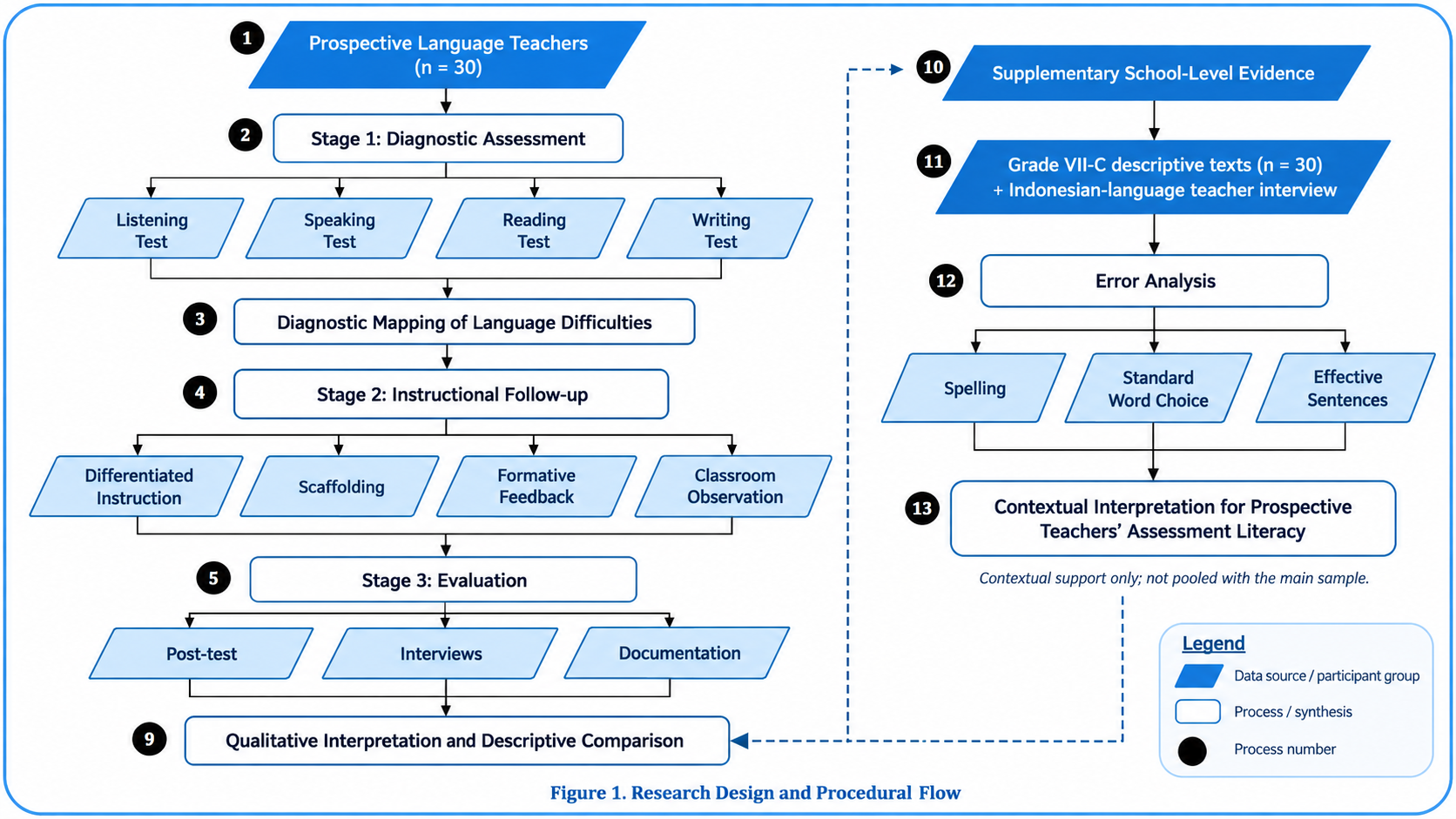
Diagnostic assessment can play a dual role in pre-service teacher education by identifying prospective teachers’ learning needs while strengthening their capacity to respond to language difficulties encountered in school settings. This study examined the use of diagnostic assessment in the language development of 30 second-semester students enrolled in the Indonesian Language and Literature Education Study Program at Universitas Negeri Surabaya, supported by an error analysis of 30 descriptive texts written by seventh-grade students at a junior high school in Surabaya. A descriptive qualitative design with purposive sampling was employed. Data were collected through diagnostic tests covering listening, speaking, reading, and writing, as well as classroom observation, interviews, and documentation, and were analyzed using the interactive model of Miles, Huberman, and Saldana. The findings identified four major areas of difficulty among the prospective teachers: standard spelling and grammar (43.3%), academic vocabulary (36.7%), paragraph coherence (50.0%), and speaking confidence (40.0%). Supplementary school-level analysis recorded 505 language errors, 87.9% of which involved spelling, with capitalization as the most frequent category. Diagnostic findings informed differentiated instruction, scaffolding, and formative feedback during a twelve-week instructional period. The mean post-test score increased by 18.4 points, while qualitative evidence indicated greater learning autonomy, speaking confidence, and metalinguistic awareness. These findings suggest that diagnostic assessment can support responsive instruction in pre-service language teacher education while strengthening prospective teachers’ assessment literacy for addressing language-learning needs in secondary-school contexts.
Downloads
##plugins.themes.bootstrap3.article.details##
Copyright (c) 2026 Mukhzamilah Mukhzamilah, Shigenori Wakabayashi

This work is licensed under a Creative Commons Attribution-ShareAlike 4.0 International License.
References
Ababneh, O. M. A. (2021). How do green HRM practices affect employees’ green behaviors? The role of employee engagement and personality attributes. Journal of Environmental Planning and Management, 64(7), 1204–1226. https://doi.org/10.1080/09640568.2020.1814708
Al Khaldy, M., Gheraibia, Y., & Shaheen, A. (2026). Multilingual large language models for low-resource languages: Challenges and opportunities. In 2026 2nd International Conference on Computational Intelligence Approaches and Applications (ICCIAA 2026) – Proceedings. https://doi.org/10.1109/ICCIAA68481.2026.11543773
Alcazaren, H. K. G. (2024). Developing language assessment literacy of Filipino pre-service teachers: Reflections from a language assessment course. TEFLIN Journal, 35(2), 216–231. https://doi.org/10.15639/teflinjournal.v35i2/216-231
Alfin, J. (2022). Analisis kesalahan berbahasa Indonesia [Analysis of Indonesian language errors]. Nasmedia.
Anam, S., & Putri, N. V. W. (2021). How literate am I about assessment: Evidence from Indonesian EFL pre-service and in-service teachers. English Review: Journal of English Education, 9(2), 151–162. https://doi.org/10.25134/erjee.v9i2.4374
Anderson, L. W., & Krathwohl, D. R. (2017). A taxonomy for learning, teaching, and assessing: A revision of Bloom’s taxonomy of educational objectives (A. Prihantoro, Trans.). Pustaka Pelajar.
Andriyani, S., Mahendra, D., Saefudin, A., Sa’idah, N., Yulistianti, H. D., & Haq, D. A. F. F. (2026). Readiness for differentiated instruction in English language learning: Perceptions of junior high school teachers and students. Sapienza: International Journal of Interdisciplinary Studies, 7(1), e26002. https://doi.org/10.51798/sijis.v7i1.1267
Atjonen, P., Pöntinen, S., Kontkanen, S., & Ruotsalainen, P. (2022). Enhancing preservice teachers’ assessment literacy: Focus on knowledge base, conceptions of assessment, and teacher learning. Frontiers in Education, 7, 891391. https://doi.org/10.3389/feduc.2022.891391
Bachman, L. F., & Palmer, A. S. (2010). Language assessment in practice: Developing language assessments and justifying their use in the real world. Oxford University Press.
Black, P., & Wiliam, D. (2018). Classroom assessment and pedagogy. Assessment in Education: Principles, Policy & Practice, 25(6), 551–575. https://doi.org/10.1080/0969594X.2018.1441807
Brown, H. D., & Abeywickrama, P. (2019). Language assessment: Principles and classroom practices (3rd ed.). Pearson Education.
Bruyninckx, S., Stevens, A.-L., Van Oss, V., Taelman, H., & Spilt, J. L. (2026). How do early childhood education teachers support language? Frequency and variation in practices across activities. Early Education and Development. https://doi.org/10.1080/10409289.2026.2663287
Cen, J.-P., Ge, S.-D., Zhou, Y.-S., Li, Y.-Z., Guo, Z.-F., Peng, R., Liu, Y.-G., Zhou, S., Xu, S.-Y., Zhao, S.-C., & Liu, D. (2026). General pathologists achieve near-specialist diagnostic performance using deep learning–based virtual staining for donor kidney assessment: A retrospective-prospective diagnostic concordance study. Laboratory Investigation, 106(4). https://doi.org/10.1016/j.labinv.2026.106077
Chen, H., & Yang, H. (2026). Explainable machine learning for predicting heritage-language adhesion from language-attitude survey data: A case study in Guangxi, China. In Proceedings of the 2026 5th International Conference on Big Data, Information and Computer Network (BDICN 2026) (pp. 174–179). https://doi.org/10.1145/3801228.3801255
Cohen, A. D. (2014). Strategies in learning and using a second language (2nd ed.). Routledge. https://doi.org/10.4324/9781315833200
Creswell, J. W., & Poth, C. N. (2018). Qualitative inquiry and research design: Choosing among five approaches (4th ed.). SAGE Publications.
Cui, Q., Hussin, S., & Wong, W. L. (2026). Reducing speaking anxiety through AI interaction: ChatGPT-assisted English-speaking practice and language proficiency development in Chinese universities. World Journal of English Language, 16(6), 524–537. https://doi.org/10.5430/wjel.v16n5p524
Dewi, F. A. (2025). Analisis kesalahan penggunaan bahasa baku dalam teks deskripsi siswa kelas VII SMP Negeri 34 Surabaya [Analysis of errors in standard-language use in descriptive texts by seventh-grade students of SMP Negeri 34 Surabaya] [Unpublished undergraduate thesis]. Universitas Negeri Surabaya.
du Plessis, T. (2025). Post-2023 language planning in South Africa: Implications for the historically marginalised indigenous languages, South African Sign Language and Afrikaans. Tydskrif vir Geesteswetenskappe, 65(1), 188–212. https://doi.org/10.17159/2224-7912/2025/v65n1a9
Duthois, T., Vanderlinde, R., Van Avermaet, P., & Montero-Perez, M. (2026). Can we professionally develop teachers’ visual attention? Video-based professional development of early childhood teachers’ in-action noticing during language-stimulating interactions: A mobile eye-tracking study. Learning and Instruction, 105, 102396. https://doi.org/10.1016/j.learninstruc.2026.102396
Farmasari, S., Wardana, L. A., Baharudin, B., Herayana, D., & Suryaningsih, H. (2023). Pre-service EFL teachers’ language assessment literacy satisfaction and assessment preparedness. International Journal of Language Education, 7(4), 646–660. https://doi.org/10.26858/ijole.v7i4.47445
Francisca Carocca, P. (2026). Beyond translation: Epistemic justice in the adaptation of the “Coding as Another Language” curriculum. Revista Iberoamericana de Tecnologias del Aprendizaje, 21, 339–345. https://doi.org/10.1109/RITA.2026.3683518
Hagen, Å. M., & Rydland, V. (2026). Preserving pedagogy, promoting language: Implementation challenges and possibilities for structured language interventions in Nordic early childhood education. Early Childhood Education Journal, 54(4), 3057–3069. https://doi.org/10.1007/s10643-025-02076-6
Hendratno, Subrata, H., Istiq’faroh, N., Saraswati, L., Fakhrudin, A., Kharisma, N. V. E., Haq, M. S., & Adebisi, A. A. (2026). The effect of AI-assisted Bing Image Creator on elementary students’ self-confidence and speaking: Fostering SDGs through education. In S. N., B. K. P., M. S., L. L., & G. M. A. (Eds.), E3S Web of Conferences (Vol. 696). EDP Sciences. https://doi.org/10.1051/e3sconf/202669602011
Hidayat, L. E., Amalia, S. N., Rohmana, W. I. M., Virdyna, N. K., Ardi, P., & Suryati, N. (2025). EFL teachers’ understanding and practices of classroom-based diagnostic assessment in differentiated instruction. In Differentiated instruction, equity, and inclusion in language education. IGI Global Scientific Publishing. https://doi.org/10.4018/979-8-3693-6497-0.ch007
Hsin, C.-T., Hsieh, M.-F., Tsao, Y.-L., Chang, W.-C., & Compton-Lilly, C. (2025). Teaching and learning indigenous languages: An Atayal book project. Journal of Early Childhood Literacy, 25(3), 556–586. https://doi.org/10.1177/14687984251320869
Hyland, K. (2019). Second language writing (2nd ed.). Cambridge University Press. https://doi.org/10.1017/9781108635547
Indihadi, D. (2021). Analisis kesalahan berbahasa. Aphorisme: Journal of Language, Literature, and Education, 2(1), 68–91. https://doi.org/10.37680/aphorisme.v2i1.671
Lantolf, J. P., & Poehner, M. E. (2014). Sociocultural theory and the pedagogical imperative in L2 education: Vygotskian praxis and the research/practice divide. Routledge.
Lee, I. (2015). Student teachers’ changing beliefs on a pre-service teacher education course in Hong Kong. In T. Wright & M. Beaumont (Eds.), Experiences of second language teacher education (pp. 31–53). Palgrave Macmillan. https://doi.org/10.1057/9781137440068_3
Levinson, T., Carocca P., F., & Bers, M. (2026). Coding as another language: An early childhood programming curriculum in Argentina. Computer Science Education, 36(2), 278–298. https://doi.org/10.1080/08993408.2025.2455339
Lincoln, Y. S., & Guba, E. G. (1985). Naturalistic inquiry. SAGE Publications.
Miles, M. B., Huberman, A. M., & Saldaña, J. (2014). Qualitative data analysis: A methods sourcebook (3rd ed.). SAGE Publications.
Moraes, I. T., Furtoso, V. A. B., & Giraldo, F. (2024). Developing pre-service teachers’ language assessment literacy: An analysis of classroom tasks. Ilha do Desterro, 77, e96898. https://doi.org/10.5007/2175-8026.2024.e96898
Mottafegh, A., & Ahn, G.-N. (2026). Adaptive human-in-the-loop optimization using language-guided priors for chemical experiments. Journal of Chemical Information and Modeling, 66(15), 8833–8847. https://doi.org/10.1021/acs.jcim.6c00976
Mullah, N. S., & Wan Zainon, W. M. N. (2026). AI and low-resource languages: Bridging the linguistic divide. In Reshaping language and cognition in education through AI (pp. 77–127). IGI Global. https://doi.org/10.4018/979-8-3373-4397-6.ch003
Musyarrofah, H., Kurniawati, A. A., Asad, A. S. A., & Fadlillah, A. (2024). Differentiated instruction in ELT: Indonesian pre-service and in-service teachers’ capabilities, strategies, and barriers. JEELS (Journal of English Education and Linguistics Studies), 11(2), 897–926. https://doi.org/10.30762/jeels.v11i2.2847
Nazilah, A. S. (2024). Diagnostic assessment in differentiated learning: Supporting learners’ needs for improved learning achievement. Research Journal on Teacher Professional Development, 2(1), 87–92. https://doi.org/10.21580/rjtpd.v2i1.20662
Nurgiyantoro, B. (2018). Penilaian pembelajaran bahasa berbasis kompetensi [Competency-based language learning assessment] (2nd ed.). BPFE Yogyakarta.
Ölmezer Öztürk, E. (2022). Developing language assessment literacy of EFL pre-service teachers through classroom assessment course. International Journal of Contemporary Educational Research, 8(3), 13–22. https://doi.org/10.33200/ijcer.932721
Pastukh, V., Beshley, P., Mokhun, S., Fedchyshyn, O., & Brych, L. (2026). Functional generative system architecture for natural language-driven control of cyber-physical systems. In 2026 IEEE 18th International Conference on Advanced Trends in Radioelectronics, Telecommunications and Computer Engineering (TCSET 2026) – Proceedings. https://doi.org/10.1109/TCSET65181.2026.11460442
Prastikawati, E. F., Mujiyanto, J., Saleh, M., & Fitriati, S. W. (2023). Language assessment course: Impact on pre-service EFL teachers’ language assessment literacy. Proceedings of International Conference on Science, Education, and Technology, 7(1), 160–167.
Prastikawati, E. F., Mujiyanto, Y., Saleh, M., & Fitriati, S. W. (2024). Teaching practicum: Does it impact to pre-service EFL teachers’ language assessment literacy? World Journal of English Language, 14(3), 242. https://doi.org/10.5430/wjel.v14n3p242
Purpura, J. E. (2016). Second and foreign language assessment. The Modern Language Journal, 100(S1), 190–208. https://doi.org/10.1111/modl.12308
Putri, N. V. W., Fitri, A., Suwandi, E., Nadif, B., Diana, R. N., & A’yun, M. Q. (2026). Exploring language assessment literacy: Indonesian pre-service English teachers’ perceived readiness for classroom assessment. Journal of Research on English and Language Learning (J-REaLL), 7(1), 212–228. https://doi.org/10.33474/j-reall.v7i1.24610
Rahmani, E. F., Riyanti, D., & Negara, K. Y. E. P. (2024). EFL pre-service teachers’ experiences in implementing differentiated instruction during teaching practice program. Jurnal Pendidikan Progresif, 14(2). https://doi.org/10.23960/jpp.v14.i2.202490
Rasoolzadeh, N., Zhang, T., Gao, Y., van Dijk, J. M., Yang, Q., Tan, T., & Mann, R. M. (2025). Multimodal breast MRI language-image pretraining (MLIP): An exploration of a breast MRI foundation model. In R. M. Mann, T. Zhang, L. Han, G. Litjens, T. Tan, D. Truhn, S. Li, Y. Gao, S. Doyle, M. M. R., J. N. Kather, K. Pinker-Domenig, & S. Wu (Eds.), Lecture Notes in Computer Science (Vol. 15451, pp. 42–53). Springer. https://doi.org/10.1007/978-3-031-77789-9_5
Refoina, R., & Rustam. (2024). The diagnostic assessment strategy in the Merdeka Curriculum for Indonesian language learning in 7th grade at junior high school. IDEAS: Journal on English Language Teaching and Learning, Linguistics and Literature, 12(2). https://doi.org/10.24256/ideas.v12i2.5572
Sepúlveda-Oviedo, E. H., Travé-Massuyès, L., Subias, A., Pavlov, M., & Alonso, C. (2025). Artificial intelligence in photovoltaic fault diagnosis: A natural language-based Topic-tSNE fusion analysis. Energy and AI, 21, 100558. https://doi.org/10.1016/j.egyai.2025.100558
Setiyadi, A. B. (2020). Teaching English as a foreign language (2nd ed.). Graha Ilmu.
Spear, C. F., Piasta, S. B., Lo, M.-T., Justice, L. M., & O’Connell, A. A. (2025). Examining naturally occurring language- and literacy-learning opportunities for children with disabilities across ECE/ECSE contexts. Topics in Early Childhood Special Education. https://doi.org/10.1177/02711214251372539
Sugiyono. (2019). Metode penelitian kualitatif [Qualitative research methods]. Alfabeta.
Suleman, M. A., & Idayanti, Z. (2024). Implementation of diagnostic assessment in Grade VI Teaching at the Right Level approach in Indonesian language lessons in elementary school. Ibriez: Jurnal Kependidikan Dasar Islam Berbasis Sains, 9(2), 137–148. https://doi.org/10.21154/ibriez.v9i2.603
Sulistio, P. H. (2023). Language assessment literacy: Cases of pre-service English teachers. IJLECR (International Journal of Language Education and Cultural Review), 9(1), 1–10. https://doi.org/10.21009/ijlecr.v9i1.33032
Susanto, G., Pickus, D., Espree-Conaway, D., Suparmi, Rusiandi, A., & Noviya, H. (2024). Indonesian language policy and perspectives on its implementation in promoting Bahasa Indonesia as an international language. Cogent Arts & Humanities, 11(1), 2364511. https://doi.org/10.1080/23311983.2024.2364511
Tarigan, H. G. (2015). Menulis sebagai suatu keterampilan berbahasa [Writing as a language skill] (Rev. ed.). Angkasa.
Universitas Negeri Surabaya. (2024). Academic guidelines of the Indonesian Language and Literature Education Study Program. Unesa Press.
Vygotsky, L. S. (1978). Mind in society: The development of higher psychological processes. Harvard University Press.
Wardhani, A. (2023). The implementation of diagnostic assessment to support differentiated instruction in English learning at SMK N 1 Pringapus. English Education Journal, 13(4), 586–595. https://doi.org/10.15294/8x9cmt48
Zapatero-Ayuso, J.-A., Díaz-Carretero, A., Gil-García, M.-I., & Gil-Madrona, P. (2026). Competence development of pre-service teachers during practicum: A qualitative study from the perspective of its protagonists. Journal of New Approaches in Educational Research, 15(1). https://doi.org/10.1007/s44322-026-00057-0
Zhong, X., & Hao, H. (2026). Cohesive gestures in discourse by Chinese-speaking individuals with aphasia. Journal of Communication Disorders, 123, 106665. https://doi.org/10.1016/j.jcomdis.2026.106665