
Designing Literacy Resilience: A Needs Analysis of the Social-Emotional Learning-Based DRAMATIKA Module for Junior Secondary Literacy Instruction
##plugins.themes.bootstrap3.article.sidebar##
##plugins.themes.bootstrap3.article.main##
 Asrofi Asrofi
 https://orcid.org/0009-0000-5149-5566
Ribut Wahyu Eriyanti
https://orcid.org/0000-0002-1602-0466
Hari Sunaryo
https://orcid.org/0009-0001-7733-8232
Daroe Iswatiningsih
https://orcid.org/0000-0002-1982-4312
 Isioma Stella Olagunju
https://orcid.org/0000-0002-7236-6330
Abstract
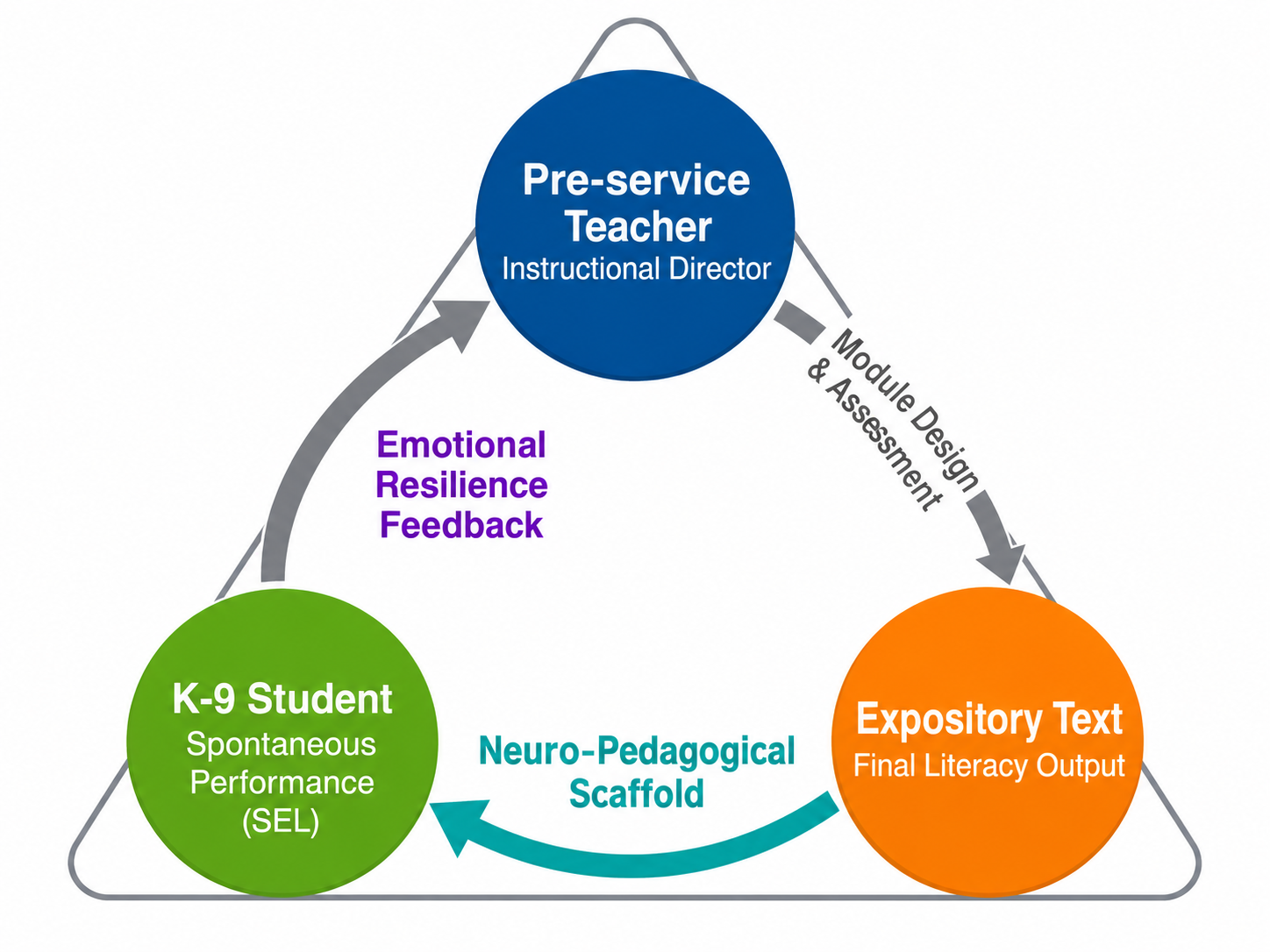
Literacy instruction in junior secondary education poses cognitive and socio-emotional challenges, particularly in developing expository writing skills, managing writing anxiety, and encouraging students to express ideas confidently. This study aimed to analyse the instructional and socio-emotional needs underpinning the development of the DRAMATIKA module, which integrates improvisational theatre and Social-Emotional Learning (SEL) to support literacy resilience. The initial phase of research and development involved a qualitative needs analysis with pre-service Indonesian language teachers and junior secondary students selected through purposive sampling. Data were collected through semi-structured interviews, classroom observations, document analysis, and a needs assessment questionnaire, and were examined using thematic analysis and data triangulation. The findings identified difficulties in organising arguments, emotional barriers to written expression, and limited pedagogical readiness among pre-service teachers to integrate drama-based activities and SEL into literacy instruction. The analysis also identified instructional requirements, including improvisational prompts, scaffolded writing activities, assessment rubrics, and visual teaching guides. These findings informed the proposed DRAMATIKA framework, positioning pre-service teachers as prospective instructional facilitators and junior secondary students as the target learners. The study concludes that integrating drama-based pedagogy with SEL offers a relevant direction for designing emotionally responsive literacy instruction. Further development and evaluation are required to establish the module's effectiveness in improving literacy resilience and writing outcomes.
Downloads
##plugins.themes.bootstrap3.article.details##
Copyright (c) 2026 Asrofi Asrofi, Ribut Wahyu Eriyanti, Hari Sunaryo, Daroe Iswatiningsih, Nurudeen Olalekan Orunbon

This work is licensed under a Creative Commons Attribution-ShareAlike 4.0 International License.
References
Al Khaldy, M., Gheraibia, Y., & Shaheen, A. (2026). Multilingual Large Language Models for Low-Resource Languages: Challenges and Opportunities. 2026 2nd International Conference on Computational Intelligence Approaches and Applications, ICCIAA 2026 - Proceedings. https://doi.org/10.1109/ICCIAA68481.2026.11543773
Andrade, F. (2026). THE DRAMATICS OF PROCESS: Acting within Not Acting in Eduardo Coutinho’s Documentaries. In Non-Professional Film Acting: Performance and Experience (pp. 67–83). Taylor and Francis. https://doi.org/10.4324/9781003598015-6
Balogh-Pécsi, A., Tóth, E., Gál, Z., & Kasik, L. (2026). The effect of a communication-focused drama-based intervention on the social problem-solving of 10–11-year-olds. European Journal of Psychology of Education, 41(1). https://doi.org/10.1007/s10212-026-01068-3
Barbour, M. S., & Debreli, E. (2026). Exploring the psychological dimensions of poetry- and drama-based instruction in EFL learning. Frontiers in Psychology, 17. https://doi.org/10.3389/fpsyg.2026.1802084
Bernstein, K. A., Moen, T., van Huisstede, L., Pierce-Rivera, M., Vargas, R., Manning, K., Galindo, K., Rotheram-Fuller, E., & Restrepo, M. A. (2026). Drama-based instruction for young multilingual students with disabilities: A case study. Bilingual Research Journal, 49(1), 113–136. https://doi.org/10.1080/15235882.2025.2599940
Bonny-Noach, H., Sinambela, Y., Hanafi, E., Shina, C., & Siste, K. (2026). Alcohol portrayals in Korean dramas: associations with global viewer attitudes and drinking behaviors. Global Health Promotion. https://doi.org/10.1177/17579759261432176
Boven, M. (2026). Dramatisation in Deleuze and Kierkegaard: Two Formulas: The Stuttering of Language, the Question That Silences. Deleuze and Guattari Studies, 20(1), 56–76. https://doi.org/10.3366/dlgs.2026.0627
Bruyninckx, S., Stevens, A.-L., Van Oss, V., Taelman, H., & Spilt, J. L. (2026). How Do Early Childhood Education Teachers Support Language? Frequency and Variation in Practices Across Activities. Early Education and Development. https://doi.org/10.1080/10409289.2026.2663287
Buitron, N. (2026). Competing for the Future: Play, Drama, and Rank in Amazonia. In Competition beyond Capitalism: Anthropological Perspectives on an Unruly Dynamic (pp. 26–47). Berghahn Books. https://doi.org/10.3167/978183695446003
Cen, J.-P., Ge, S.-D., Zhou, Y.-S., Li, Y.-Z., Guo, Z.-F., Peng, R., Liu, Y.-G., Zhou, S., Xu, S.-Y., Zhao, S.-C., & Liu, D. (2026). General Pathologists Achieve Near-Specialist Diagnostic Performance Using Deep Learning–Based Virtual Staining for Donor Kidney Assessment: A Retrospective-Prospective Diagnostic Concordance Study. Laboratory Investigation, 106(4). https://doi.org/10.1016/j.labinv.2026.106077
Chen, H., & Yang, H. (2026). Explainable Machine Learning for Predicting Heritage-Language Adhesion from Language-Attitude Survey Data: A Case Study in Guangxi, China. Proceedings of 2026 5th International Conference on Big Data, Information and Computer Network, BDICN 2026, 174–179. https://doi.org/10.1145/3801228.3801255
Cinkrautová, K. (2026). Conceptualization of ILLNESS in the Artistic Text (The White Disease by Karel Čapek). Bohemistyka, 26(1), 97–108. https://doi.org/10.14746/bo.2026.1.6
Cui, Q., Hussin, S., & Wong, W. L. (2026). Reducing Speaking Anxiety through AI Interaction: ChatGPT-Assisted English-Speaking Practice and Language Proficiency Development in Chinese Universities. World Journal of English Language, 16(6), 524–537. https://doi.org/10.5430/wjel.v16n5p524
du Plessis, T. (2025). Post-2023 language planning in South Africa: Implications for the historically marginalised indigenous languages, South African Sign Language and Afrikaans. Tydskrif vir Geesteswetenskappe, 65(1), 188–212. https://doi.org/10.17159/2224-7912/2025/v65n1a9
Dumitru, C., Mastrothanasis, K., Pikoulis, E., Kladaki, M., Zervoudakis, K., Dogan, C. D., Gonullu, I., Stan, M. M., Karamagioli, E., Ledaki, M., Alexopoulos, P., Papantoniou, D., Pikouli, A., Papantoniou, S., & Erden, S. (2026). Drama-based simulations in first aid education: psychometric validation of a student assessment tool in school settings. Frontiers in Public Health, 14. https://doi.org/10.3389/fpubh.2026.1710189
Duthois, T., Vanderlinde, R., Van Avermaet, P., & Montero-Perez, M. (2026). Can we professionally develop teachers’ visual attention? Video-based professional development of early childhood teachers’ in-action noticing during language-stimulating interactions: A mobile eye-tracking study. Learning and Instruction, 105. https://doi.org/10.1016/j.learninstruc.2026.102396
Ezell, B. (2026). A Dramatic Answer to The Hard Problem. Modern Drama, 69(2–3), 265–287. https://doi.org/10.3138/md-69-2-3-1413
Francisca Carocca, P. (2026). Beyond Translation: Epistemic Justice in the Adaptation of the “Coding as Another Language” Curriculum. Revista Iberoamericana de Tecnologias Del Aprendizaje, 21, 339–345. https://doi.org/10.1109/RITA.2026.3683518
Gray, C. C., & O’Rourke, J. (2026). Brilliant little things: drama-based mindfulness to support pre-service teacher wellbeing. Reflective Practice, 27(4), 543–557. https://doi.org/10.1080/14623943.2025.2608290
Guest, M., Johnson, B., Pistono, M., Kruser, J. M., Vasilevskis, E. E., & Golden, B. P. (2026). Depiction of Delirium in Contemporary Medical Television Dramas: A Descriptive Content Analysis. Journal of the American Geriatrics Society. https://doi.org/10.1111/jgs.70565
Hagen, Å. M., & Rydland, V. (2026). Preserving Pedagogy, Promoting Language: Implementation Challenges and Possibilities for Structured Language Interventions in Nordic Early Childhood Education. Early Childhood Education Journal, 54(4), 3057–3069. https://doi.org/10.1007/s10643-025-02076-6
Hendratno, Subrata, H., Istiq’ faroh, N., Saraswati, L., Fakhrudin, A., Kharisma, N. V. E., Haq, M. S., & Adebisi, A. A. (2026). The effect of Al-assisted bing image creator of elementary students’self-confidence and speaking: Fostering SDGs through education. In S. N., P. B.K., S. M., L. L., & A. G. M. (Eds.), E3S Web of Conferences (Vol. 696). EDP Sciences. https://doi.org/10.1051/e3sconf/202669602011
Hsin, C.-T., Hsieh, M.-F., Tsao, Y.-L., Chang, W.-C., & Compton-Lilly, C. (2025). Teaching and learning indigenous languages: An Atayal book project. Journal of Early Childhood Literacy, 25(3), 556–586. https://doi.org/10.1177/14687984251320869
Karakechagia, C., Sini, V. M., Chasou, E.-C., Feidakis, M., Michalopoulos, A.-P., & Nikolaou, G. (2026). An Experiential, Technology-Enhanced Anti-Bullying Intervention: Combining Drama-Based Learning and Educational Robotics to Foster Empathy and Active Bystanders. In T. E., D. M. T., & M. C. (Eds.), International Conference on Computer Supported Education, CSEDU - Proceedings (Vol. 2, pp. 1607–1613). Science and Technology Publications, Lda. https://doi.org/10.5220/0014830700004021
Karantonis, D. (2026). The Use of Drama-Based Interventions to Enhance Social Communication Skills in Students With Autism Spectrum Disorder: A Cross-Cultural Perspective. In Inclusive and Language-Focused Innovations in Education (pp. 237–259). IGI Global Scientific Publishing. https://doi.org/10.4018/979-8-2600-1563-6.ch011
Landry-Wegener, B. A., Bertram, A., Pastides, A., & Sozio, S. M. (2026). Study on a drama-based Relational Empathy and Communication Training (REACT) to improve medical student empathy. BMC Medical Education, 26(1). https://doi.org/10.1186/s12909-026-08996-0
Lett, J. (2026). CHRISTOLOGY, DRAMA, AND VICARIOUS REPRESENTATION: Hans Urs von Balthasar’s Theology of Stellvertretung1. In Who is Jesus Christ for Us Today? Evangelical Christology Seventeen Centuries after Nicaea (pp. 140–157). Taylor and Francis. https://doi.org/10.4324/9781003681601-10
Levinson, T., Carocca P, F., & Bers, M. (2026). Coding as another language: an early childhood programming curriculum in Argentina. Computer Science Education, 36(2), 278–298. https://doi.org/10.1080/08993408.2025.2455339
Liu, R., Pu, Y., & Cui, P. (2026). Drama-in-education in rural Chinese primary schools: effects on self-concept, social connectedness, and psychosocial wellbeing. Frontiers in Public Health, 14, 1812030. https://doi.org/10.3389/fpubh.2026.1812030
Ma, B., & Du, X. (2026). Multidimensional drama-exercise intervention for attentional networks and core symptoms in children with autism: A Randomized controlled trial protocol. Mental Health and Prevention, 43. https://doi.org/10.1016/j.mhp.2026.200531
Matuseviciute, G., Janiunaite, B., & Lysgaard, J. A. (2026). Weaving pedagogies for the development of sustainability mindset: a framework integrating critical, dark, and drama-based approaches. Environmental Education Research, 32(9), 2744–2764. https://doi.org/10.1080/13504622.2026.2659604
Maupu, C., Ennesser, G., Baron-Menguy, C., Bodet, M., Loirand, G., Vion, A.-C., & Boulaftali, Y. (2026). Platelets in Intracranial Aneurysm: The Missing Actors in the Drama? Arteriosclerosis, Thrombosis, and Vascular Biology, 46(3), e323171. https://doi.org/10.1161/ATVBAHA.125.323171
Mottafegh, A., & Ahn, G.-N. (2026). Adaptive human-in-the-loop optimization using language-guided priors for chemical experiments. Journal of Chemical Information and Modeling, 66(15), 8833–8847. https://doi.org/10.1021/acs.jcim.6c00976
Mullah, N. S., & Wan Zainon, W. M. N. (2026). AI and Low-Resource Languages: Bridging the Linguistic Divide. In Reshaping Language and Cognition in Education Through AI (pp. 77–127). IGI Global. https://doi.org/10.4018/979-8-3373-4397-6.ch003
Ng, H. W. (2026). The Chinese Censorship Discourse on Television Dramas: Worrying about the Audience in Postsocialist China. In The Chinese Censorship Discourse on Television Dramas: Worrying about the Audience in Postsocialist China. Taylor and Francis. https://doi.org/10.4324/9781003471684
Pastukh, V., Beshley, P., Mokhun, S., Fedchyshyn, O., & Brych, L. (2026). Functional Generative System Architecture for Natural Language-Driven Control of Cyber-Physical Systems. 2026 IEEE 18th International Conference on Advanced Trends in Radioelectronics, Telecommunications and Computer Engineering, TCSET 2026 - Proceedings. https://doi.org/10.1109/TCSET65181.2026.11460442
Peltonen, L., & Ning, Z. (2026). Examining how L2MSS motivation and international posture manifest in a drama-based pedagogical course at a private university in China. Language Teaching Research. https://doi.org/10.1177/13621688261430058
Rasoolzadeh, N., Zhang, T., Gao, Y., van Dijk, J. M., Yang, Q., Tan, T., & Mann, R. M. (2025). Multimodal Breast MRI Language-Image Pretraining (MLIP): An Exploration of a Breast MRI Foundation Model. In R. M. Mann, T. Zhang, L. Han, G. Litjens, T. Tan, D. Truhn, S. Li, Y. Gao, S. Doyle, M. M. R, J. N. Kather, K. Pinker-Domenig, & S. Wu (Eds.), Lecture Notes in Computer Science (including subseries Lecture Notes in Artificial Intelligence and Lecture Notes in Bioinformatics): 15451 LNCS (pp. 42–53). Springer Science and Business Media Deutschland GmbH. https://doi.org/10.1007/978-3-031-77789-9_5
Rissler, M., Flening, E., & Peters, A.-K. (2026). Unearthing imaginaries: drama-based pedagogy for speculative futures of AI in higher education. Learning, Media and Technology, 51(3), 414–430. https://doi.org/10.1080/17439884.2026.2678195
Sepúlveda-Oviedo, E. H., Travé-Massuyès, L., Subias, A., Pavlov, M., & Alonso, C. (2025). Artificial intelligence in photovoltaic fault diagnosis: A Natural Language-Based Topic-tSNE Fusion analysis. Energy and AI, 21. https://doi.org/10.1016/j.egyai.2025.100558
Šoškić, R. V. (2026). THEATRE AS ONTOLOGY: DRAMATURGICAL FORM AND PHILOSOPHICAL INQUIRY IN TOM STOPPARD’S CREATIVE ACTIVITY. Philological Class, 31(2), 110–118. https://doi.org/10.26170/2071-2405-2026-31-2-110-118
Spear, C. F., Piasta, S. B., Lo, M.-T., Justice, L. M., & O’Connell, A. A. (2025). Examining Naturally Occurring Language- and Literacy-Learning Opportunities for Children with Disabilities Across ECE/ECSE Contexts. Topics in Early Childhood Special Education. https://doi.org/10.1177/02711214251372539
Steppat, M. (2026). English Drama, African Impulses A: Fresh Look. In Reconfiguring African Studies: A Collaborative Glossary (pp. 61–80). Transcript-Verlag. https://www.scopus.com/pages/publications/105051255350?origin=resultslist
Stoeva, N. V. (2026). The Phenomenon of Irony in the Dramaturgy of Vadim Shershenevich. Theatre. Fine Arts. Cinema. Music, 2026(1), 107–125. https://doi.org/10.35852/2588-0144-2026-1-107-125
Stone, A. (2026). JOANNA BAILLIE AS A PHILOSOPHICAL DRAMATIST. Journal of Scottish Philosophy, 23(3), 167–185. https://doi.org/10.3366/jsp20250423
Tilland, B. (2026). K-Dramas That Hurt and Heal. In Snapshots and Soundbites of Korean Culture (pp. 57–59). Taylor and Francis. https://doi.org/10.4324/9781003591689-22
Tukhto, М. Y. (2026). Leonid Andreev’s “Small Drama”: The Idea of a “Comedienne”-Caricature. Literary Fact, 2026(39), 8–26. https://doi.org/10.22455/2541-8297-2026-39-08-26
Uzunlu, Ş., Sayar, S. E., Çalım, G. A., & Çapık, C. (2026). Effect of a creative drama-based educational ıntervention on menstrual attitudes and genital hygiene behaviors in adolescent girls: a randomized controlled trial. BMC Public Health, 26(1). https://doi.org/10.1186/s12889-026-26331-6
Vericat, F. L., & Llorens-Cubedo, D. (2026). T. S. Eliot’s Drama: Critical Perspectives. In T. S. Eliot’s Drama: Critical Perspectives. Edinburgh University Press. https://www.scopus.com/pages/publications/105032957224?origin=resultslist
Wegmann, M., Lemos, M., Fink, D., Scherg, A., & Elsner, F. (2026). Finding the right words: preparing medical students for communication on the wish for hastened death - medical students’ perceptions of drama-based and online communication training. BMC Medical Education, 26(1). https://doi.org/10.1186/s12909-026-10403-7
Xiong, M., & Teo, T. (2026). Learner Agency and the Negotiation of EFL Motivation in GenAI-Mediated Drama-Based Learning: A Qualitative Case Study. TESOL Quarterly. https://doi.org/10.1002/tesq.70235
Yuana, S. L., & Sebayang, T. G. (2026). Acting out peace: the role of dramaturgy in peace studies in higher education. Teaching in Higher Education, 31(3), 555–573. https://doi.org/10.1080/13562517.2025.2610217
Zakopoulos, V. (2023). Drama/Theatre Performance in Education through the Use of Digital Technologies for Enhancing Students’ Sustainability Awareness: A Literature Review. In Sustainability Switzerland (Vol. 15, Number 18). https://doi.org/10.3390/su151813387
Zapatero-Ayuso, J.-A., Díaz-Carretero, A., Gil-García, M.-I., & Gil-Madrona, P. (2026). Competence development of pre-service teachers during Practicum: a qualitative study from the perspective of its protagonists. Journal of New Approaches in Educational Research, 15(1). https://doi.org/10.1007/s44322-026-00057-0
Zhong, X., & Hao, H. (2026). Cohesive gestures in discourse by Chinese-speaking individuals with aphasia. Journal of Communication Disorders, 123. https://doi.org/10.1016/j.jcomdis.2026.106665