
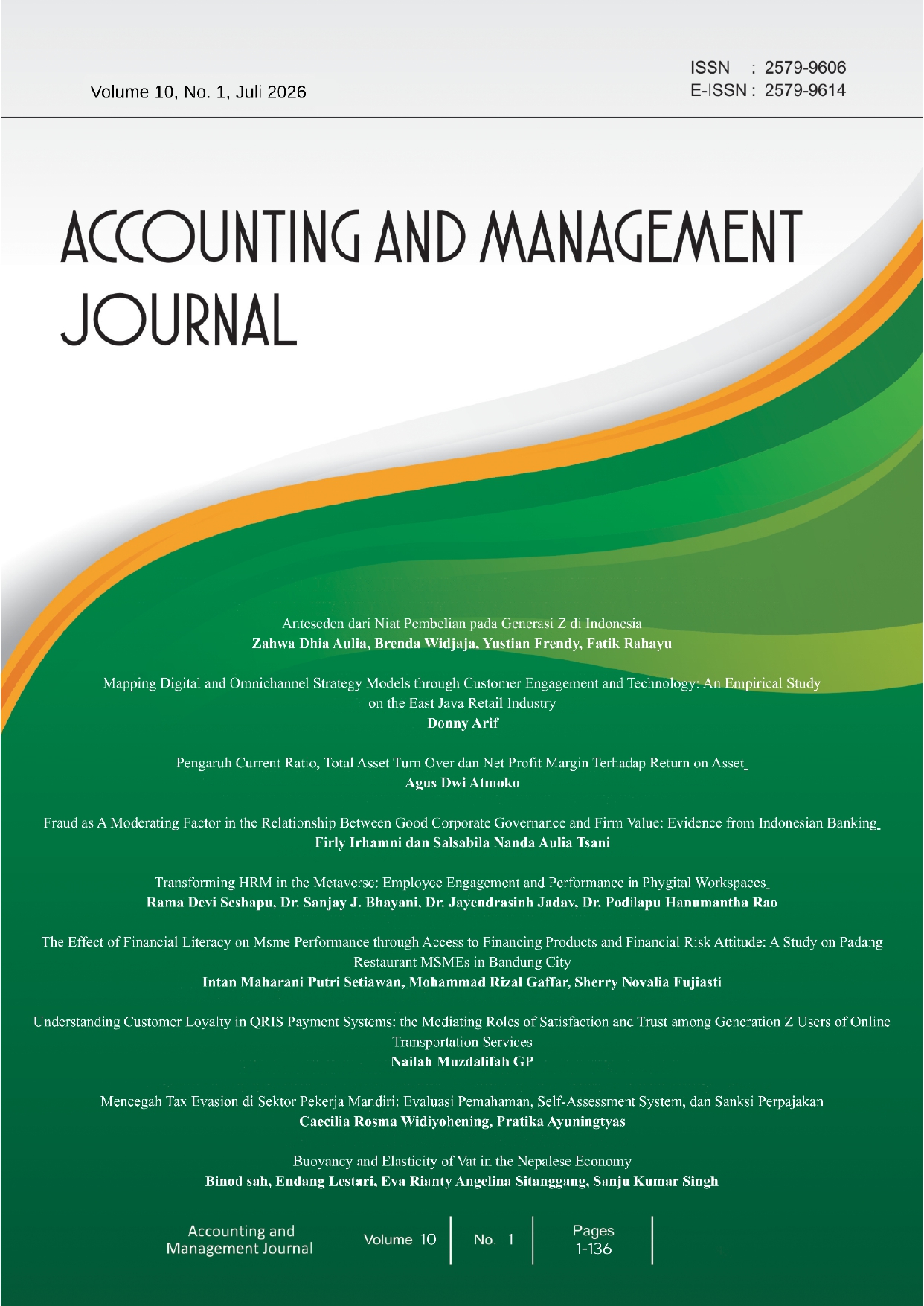
Transforming HRM in the Metaverse: Enhancing Employee Engagement and Collaboration in Phygital Workspaces
##plugins.themes.bootstrap3.article.sidebar##
##plugins.themes.bootstrap3.article.main##
 Rama Devi Seshapu
Sanjay Bhayani
Jayendrasinh Jadav
Podilapu Hanumantha Rao
Rama Devi Seshapu
Sanjay Bhayani
Jayendrasinh Jadav
Podilapu Hanumantha Rao
Abstract
This study examined how immersive metaverse workspaces relate to employee engagement and performance in phygital work settings. A cross-sectional online survey produced 175 usable responses from employees and HR professionals aged 18–35 who had experience with Roblox, Decentraland, or Meta Horizon. The proposed model was assessed using confirmatory factor analysis and structural equation modeling. Immersive metaverse workspaces were positively associated with employee engagement (β = 0.59, p < 0.001), while avatar realism and social presence were positively associated with perceived employee performance (β = 0.47, p < 0.01). Experiential HR elements—augmented reality, NFT-based recognition, and sensory design—strengthened the relationship between immersive workspaces and engagement (interaction β = 0.33, p < 0.05). The study contributes by defining phygital HRM as the coordinated design of physical and immersive digital work experiences and by testing a role-consistent model grounded in employee engagement, social presence, media richness, and job resources. The findings suggest that HR managers should evaluate immersive tools as work-design resources while also addressing accessibility, privacy, digital fatigue, and ethical avatar use. Because the data were cross-sectional and self-reported, the results indicate associations rather than causal effects.
Downloads
##plugins.themes.bootstrap3.article.details##
Copyright (c) 2026 Rama Devi Seshapu, Sanjay Bhayani, Jayendrasinh Jadav, Podilapu Hanumantha Rao

This work is licensed under a Creative Commons Attribution-ShareAlike 4.0 International License.
References
Ahn, S., Jin, B. E., & Seo, H. (2024). Why do people interact and buy in the metaverse? Journal of Business Research, 175, 114557.
Bao, W., Hudders, L., Yu, S., & Beuckels, E. (2024). Virtual luxury in the metaverse: NFT-enabled value recreation. International Journal of Research in Marketing.
Batat, W. (2024). Phygital customer experience in the metaverse: A study of sensory perception. Journal of Retailing and Consumer Services, 78, 103786.
Belk, R. (2013). Extended self in a digital world. Journal of Consumer Research, 40(3), 477–500.
Belk, R. (2024). The digital frontier as a liminal space. Journal of Consumer Psychology, 34(1), 167–73.
Belk, R., Humayun, M., & Brouard, M. (2022). Money, possessions, and ownership in the metaverse. Journal of Business Research, 153, 198–205.
Barrera, K. G., & Shah, D. (2023). Marketing in the metaverse: Framework and research agenda. Journal of Business Research, 155, 113420.
Bélisle, J. F., & Bodur, H. O. (2010). Perception of consumers based on avatars in virtual worlds. Psychology & Marketing, 27(8), 741–65.
Cyr, D., Hassanein, K., Head, M., & Ivanov, A. (2007). The role of social presence in e-service loyalty. Interacting with Computers, 19(1), 43–56.
Eggenschwiler, M., Linzmajer, M., Roggeveen, A. L., & Rudolph, T. (2024). Retailing in the metaverse: Managerial considerations. Journal of Retailing and Consumer Services, 79, 103791.
Etemad-Sajadi, R. (2016). Real-time interactivity using avatars. Computers in Human Behavior, 61, 227–232.
Gadalla, E., Keeling, K., & Abosag, I. (2013). Metaverse-retail service quality. Journal of Marketing Management, 29(13-14), 1493–1517.
Gleim, M., McCullough, H., Ferrell, O. C., & Gabler, C. (2024). Metaverse: Shifting the reality of services. Journal of Services Marketing, 38(1), 13–27.
Gleim, M. R., Stevens, J. L., & Johnson, C. M. (2023). Platform marketplaces and virtual exchange. European Journal of Marketing, 57(1), 1–28.
Hadi, R., Melumad, S., & Park, E. S. (2024). The Metaverse: A new frontier for consumer behavior. Journal of Consumer Psychology, 34(1), 142–166.
Hennig-Thurau, T., et al. (2023). Social interactions in the metaverse: Initial evidence and roadmap. Journal of the Academy of Marketing Science, 51(4), 889–913.
Hilken, T., et al. (2022). Bridging imagination gaps via AR. Journal of Interactive Marketing, 57(2), 356–75.
Holzwarth, M., Janiszewski, C., & Neumann, M. M. (2006). Influence of avatars on shopping behavior. Journal of Marketing, 70(4), 19–36.
Kim, D. Y., Lee, H. K., & Chung, K. (2023). Avatar realism and user-avatar relationship. Journal of Retailing and Consumer Services, 73, 103382.
Koles, B., Audrezet, A., et al. (2024). Authentic virtual influencers in the metaverse. Journal of Business Research, 170, 114325.
Lu, S., & Mintz, O. (2023). Marketing on the metaverse: Opportunities and challenges. AMS Review, 13, 151–166.
Mehrotra, A., et al. (2024). Customer experience in metaverse retailing. Journal of Retailing and Consumer Services, 79, 103876.
Papagiannidis, S., et al. (2013). Simulated experience in virtual retail and purchase intentions. Journal of Marketing Management, 29(13-14), 1462–1492.
Puntoni, S. (2024). Already here: Metaverse in touch and sound. Journal of Consumer Psychology, 34(1), 174–176.
Rauschnabel, P. A., et al. (2022). What is AR marketing? Journal of Business Research, 142, 1140–1150.
Roggeveen, A. L., & Sethuraman, R. (2020). Customer-interfacing retail technologies. Journal of Retailing, 96(3), 299–309.
Sung, E. (Christine), et al. (2023). NFT luxury brand marketing in the metaverse. Psychology & Marketing, 40(11), 2306–2325.
Tan, Y. C., Chandukala, S. R., & Reddy, S. K. (2022). AR in retail and impact on sales. Journal of Marketing, 86(1), 48–66.
Yim, M. Y. C., Chu, S. C., & Sauer, P. L. (2017). AR technology for e-commerce: Interactivity perspective. Journal of Interactive Marketing, 39(1), 89–103.
Yoo, K., Welden, R., Hewett, K., & Haenlein, M. (2023). The merchants of Meta: Future of metaverse retail. Journal of Retailing, 99(2), 173–192.